The leading edge of a wind turbine blade is one of the most punishing environments in renewable energy. At tip speeds routinely exceeding 80 to 100 metres per second, blades endure relentless impacts from raindrops and hailstones. This leading-edge erosion degrades the aerodynamic profile, increasing drag and cutting annual energy production (AEP) by 1% to 5%.
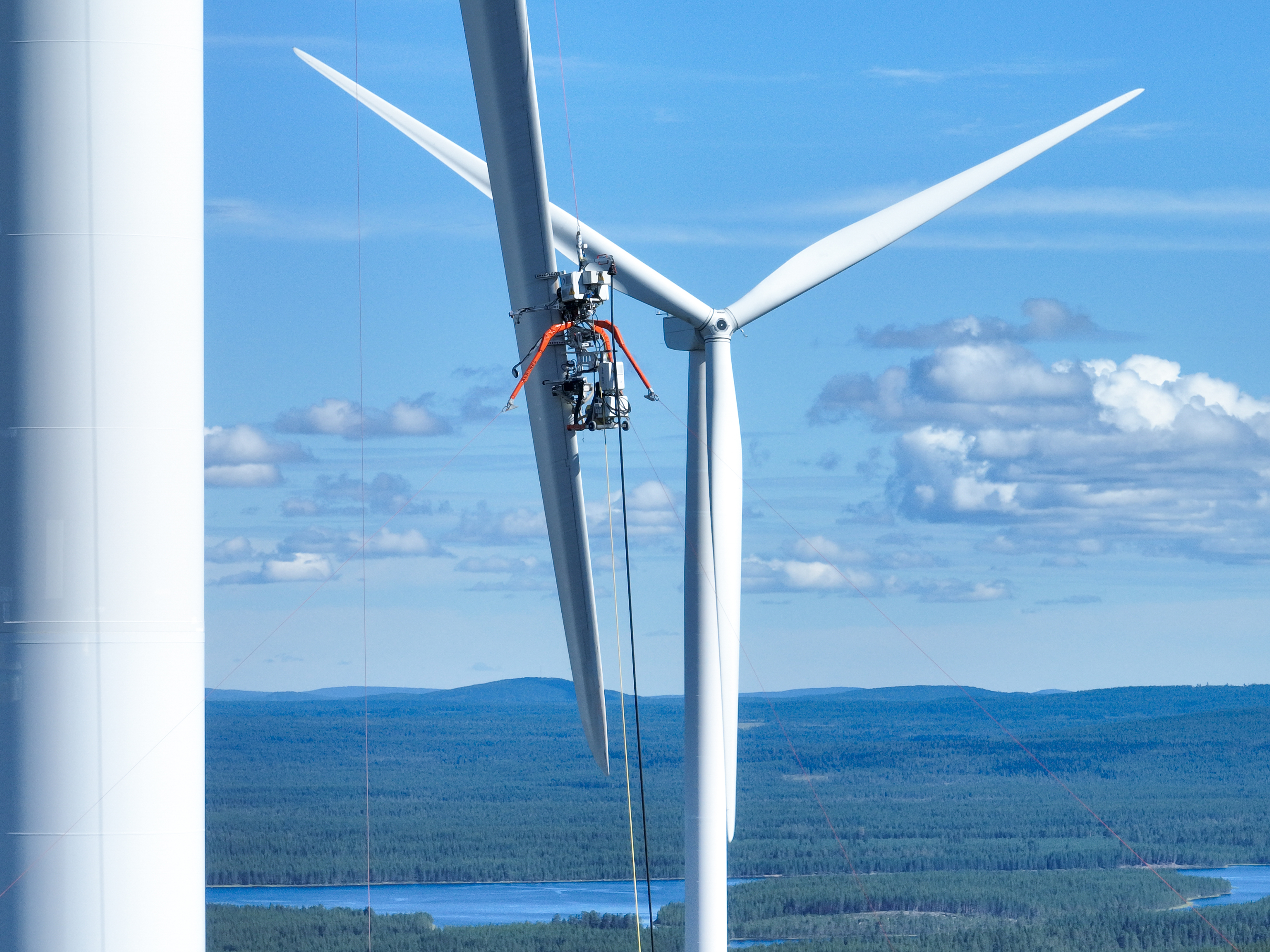
Traditional manual repairs via rope access are slow, weather-dependent and highly variable in quality. To address this challenge, Aerones has introduced automated, purpose-built robotic systems designed to deliver factory-grade preventive maintenance directly at the tower.
The massive cost of repair delays
Erosion damage accelerates rapidly, causing maintenance costs and energy losses to skyrocket across a fleet:
- Category 2 (Year 2): Minor surface degradation emerges. Repair costs average $5,400 per turbine, with an AEP loss of 65 MWh.
- Category 4 (Year 4): Deep substrate exposure occurs. Costs jump to $16,200 per turbine, with AEP losses reaching 258 MWh.
- Category 5 (Year 5): Severe damage pushes repair costs to $32,400 per turbine and AEP losses to 390 MWh.
For a fleet of 170+ turbines, delaying maintenance leads to roughly $3.1 million in avoidable costs every year.
Automated repair in 5 steps
The Aerones Leading-Edge Repair (LER) system uses a stabilized robotic platform to completely eliminate human inconsistency in high winds. It executes a precise, automated sequence:
- Surface prep: Cleans, dries and removes old protection tape automatically.
- Precision sannding: Roughens the surface to exact technical specifications for perfect coating adhesion.
- Filler application: Restores the blade's original aerodynamic profile with a geometric spatula tool.
- Smoothness grinding: Eliminates cured imperfections and clears away residual dust.
- LEP coating: Sprays a uniform, micro-smooth layer of Leading-Edge Protection.
The speed advantage
This entire process takes just 20 active hours (2 working days) per turbine. Manual rope access for the same repair requires up to 93 hours (9+ days).
Verified performance: adhesion and rain testing
Robotic precision allows operators to use highly durable materials that cannot be easily applied by hand:
- 4x better erosion resistance: In independent Rain Erosion Testing (RET) at 130 m/s, standard protective tapes failed at 28–38 hours. Aerones’ two-layer sprayable system lasted over 200+ hours without damage.
- Stronger substrate bonding: Robotic preparation yields ultra-smooth finishes below 5 gloss units (GU). This creates structural adhesion forces on epoxy substrates of 8.42–9.04 MPa, significantly higher than manual rollers can achieve.
Looking ahead
Aerones is currently pioneering UV-curable LEP materials that harden in seconds under ultraviolet light. This will enable a fully closed-loop, automated repair ecosystem capable of fixing severe structural damage in almost any weather window.
How is your team using automated O&M strategies to mitigate rising rope-access constraints? Share your thoughts in the comments below.
Looking for the full technical breakdown? To read the complete spotlight interview on automated leading-edge repair science, visit the original article on the PES Wind website: https://pes.eu.com/exclusive-articles/closing-the-quality-gap-the-science-of-robotic-blade-leading-edge-repair