Offshore infrastructure demands equipment that is not only robust but reliable over the long term, particularly for the deployment and management of risers, pipelines, and subsea cables. Hang-off clamps (HOCs) are critical safeguards in this ecosystem, managing loads and preventing damage during installation and operation.
Traditionally, HOCs have been constructed from metal, relying on resin sealing and complex earthing systems. While effective, these conventional designs come with limitations: high weight, susceptibility to corrosion and hydrogen embrittlement, and environmental concerns associated with resins.
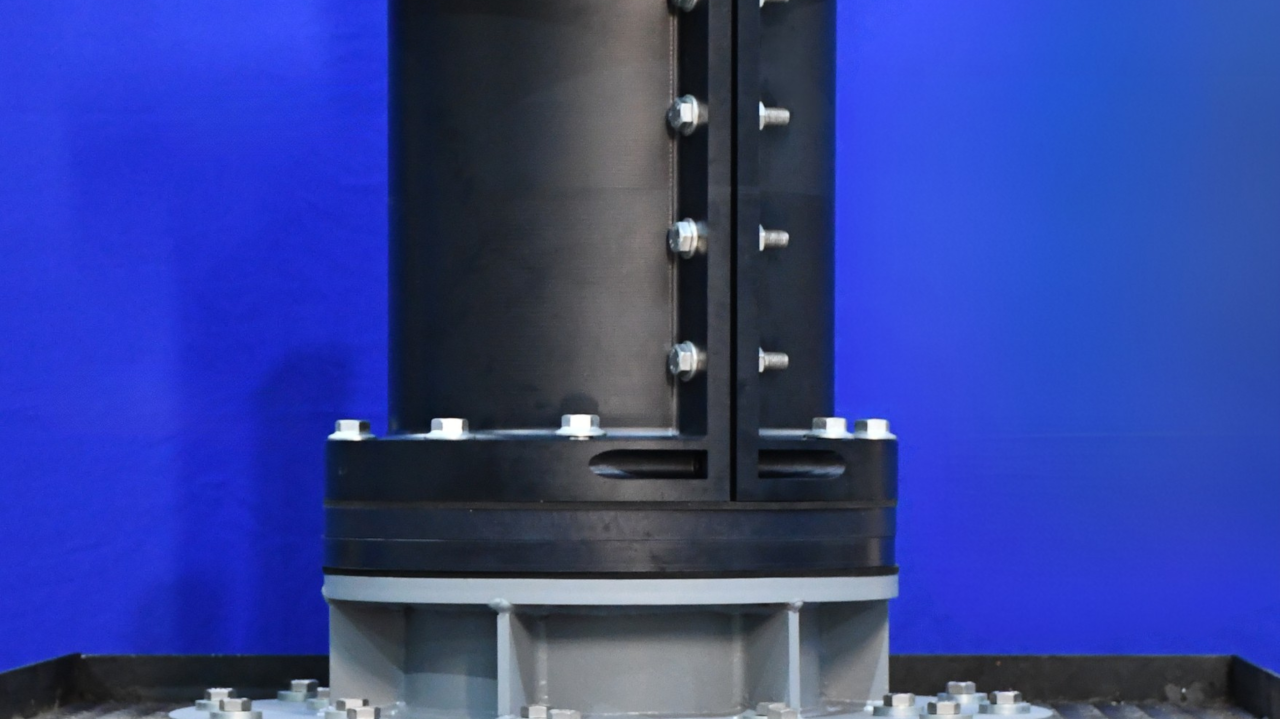
Enter the Nyla-HOC, an engineered polymer-based solution designed to surpass these limitations while maintaining the rigorous performance standards of the offshore wind and subsea industries.
Solving the Hydrogen & Corrosion Problem
Hydrogen exposure in high-pressure environments can degrade metals—a critical issue for monopiles where corrosive seawater and oxygen ingress intensify vulnerability.
- Immunity to Hydrogen Embrittlement: Engineered polymers like Nylon CF110 are immune to hydrogen-induced degradation, offering a durable, future-ready solution for monopiles.
- Corrosion-Free: Unlike metals, the polymer material requires no protective coatings or periodic integrity checks, ensuring lasting performance even in harsh offshore conditions without the risk of rust or chemical degradation.
Simplified Safety: Eliminating Earthing Requirements
In medium- to high-voltage environments, cable clamping is vital for safety. Traditional metallic clamps require complex earthing to protect against static build-up and faults.
- Natural Insulation: The Nyla-HOC acts as an insulator, creating a protective sleeve that isolates errant current flows. This eliminates the need to earth the HOC to the transition piece, preventing potential differences in case of a fault.
- Efficiency Gains: Removing earthing requirements eliminates the need for earth straps, bonding clamps, and post-installation continuity testing. This streamlines installation, reduces material costs, and minimizes administrative burden.
The Material Advantage: Industrial Nylon CF110
At the core of this innovation is Nylon CF110, an ultra-creep-resistant cast nylon developed exclusively by Nylacast. With a 35-year track record in renewable energy and subsea applications, it offers:
- Structural Compliance: Ability to withstand substantial mechanical stresses and dynamic loads.
- Superior Grip: A higher coefficient of friction for clamping compared to metal solutions.
- Resilience: Resistance to permanent deformation under sustained tension.
Commercial & Operational Benefits
Adopting polymer technology offers tangible commercial advantages:
- Weight Reduction: Lighter components mean reduced transport costs and increased deck load capacity.
- Faster Installation: Immediate installation without resin curing times (which can take up to 2 days) or complex earthing procedures.
- Lower Lifecycle Costs: Eliminating coatings, resin maintenance, and corrosion repairs significantly reduces OpEx.
A Sustainable Step Forward
The shift to polymer clamps supports broader sustainability goals. By eliminating harmful marine resins and the energy-intensive transport of heavy metals, the Nyla-HOC reduces the environmental footprint of offshore projects. It creates a cleaner, safer working environment free from the emissions associated with traditional coating processes.
Verified through rigorous independent testing for pressure, pull, and age performance, the Nyla-HOC sets a new benchmark. It proves that rethinking traditional approaches with advanced materials can deliver superior performance, safety, and efficiency for the global offshore industry.





_edited-300dpi-1.png)