More powerful turbines place greater demands on the drivetrain. Components need to handle increasing torque while reliability, turbine uptime and cost remain just as important.
For Torsten Philipp, CEO of Geislinger, the answer is not simply stronger components. Innovation, manufacturing, monitoring and collaboration all need to develop together.
Philipp identifies a central challenge for the wind industry: finding the right balance between introducing new technologies and industrialising proven designs.
Too many new developments can place pressure on manufacturing and profitability, while too little innovation risks reducing competitiveness.
For drivetrain technology, priorities include:
- Higher torque and power density
- Reliable component performance
- Noise and vibration reduction
- Consistent manufacturing quality
- Stronger regional supply chains
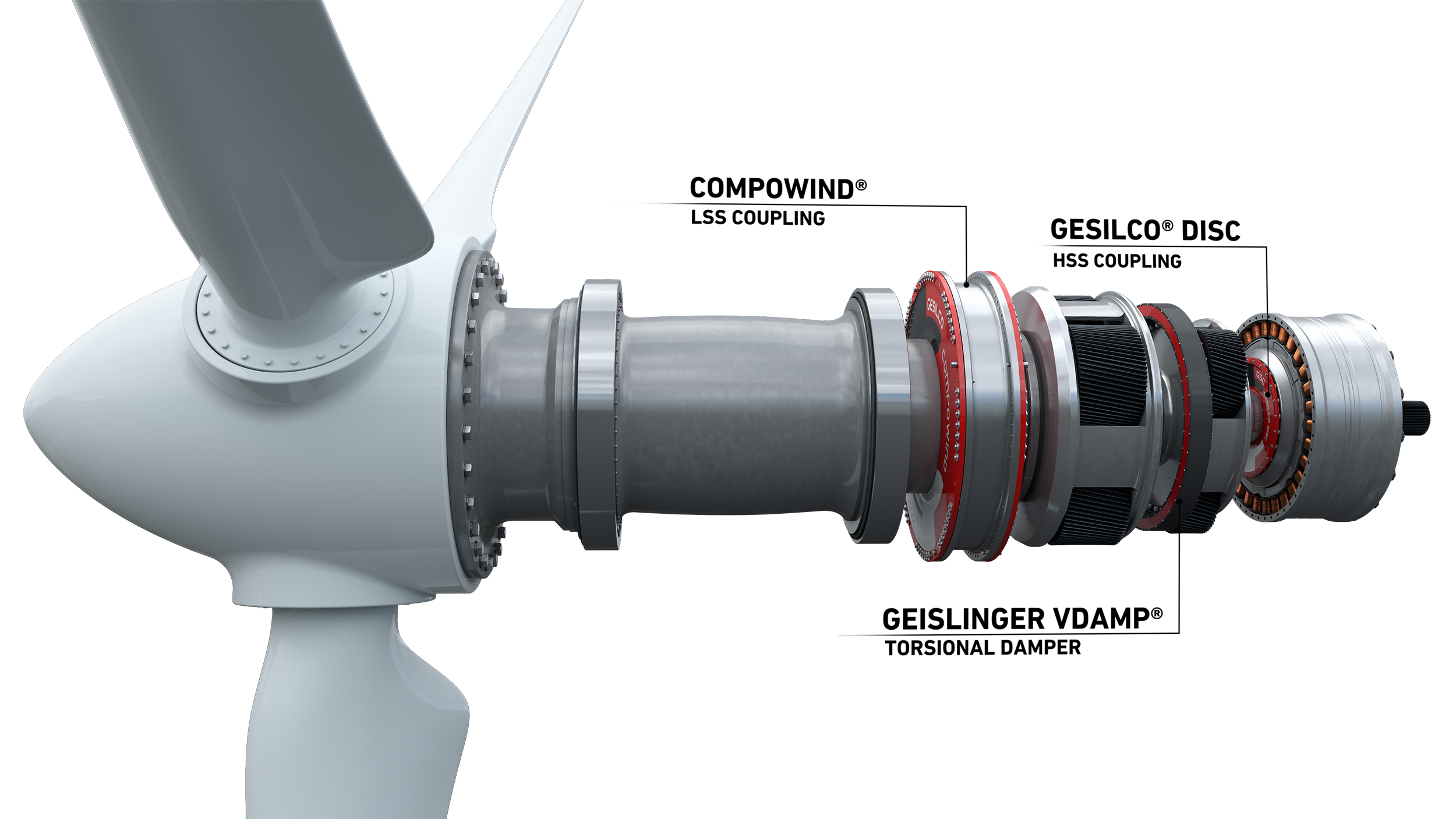
Geislinger says its work in wind has included low-speed shaft couplings, gearbox-integrated vibration damping and carbon fibre components for planetary gearboxes.
Building more resilient supply chains
Philipp believes that global execution increasingly needs to work alongside regional manufacturing.
Geislinger operates three plants in Europe, three in Asia and one in the US. The company’s approach is to give regional facilities greater independence while coordinating technology, processes and quality control through its Austrian headquarters.
For wind customers, local production can help address regional requirements and response times, while standardisation supports consistent component performance.
Monitoring drivetrain behaviour
Digital monitoring is becoming increasingly important as drivetrain loads rise.
Geislinger uses sensors to collect high-frequency data directly from rotating components. This information can be transferred to cloud infrastructure for analysis, benchmarking and integration with other condition monitoring systems (CMS).
According to Philipp, increasing torque density and the introduction of plain bearings in modern gearboxes make closer monitoring of powertrain behaviour increasingly important.
The company says machine-learning algorithms can use these datasets to detect anomalies, compare assets across a wind farm and identify developing problems earlier.
Moving beyond failure prevention
Preventing catastrophic failures remains an essential function of condition monitoring, but Philipp sees a broader opportunity.
Combining anomaly detection with fleet-wide benchmarking could support:
- Earlier identification of drivetrain problems
- More targeted maintenance
- Improved turbine uptime
- Better understanding of component behaviour
- More accurate assessment of asset life
Geislinger draws on experience from the maritime sector, where unplanned downtime has immediate financial consequences and monitoring is already used to support predictive maintenance.
Preparing for higher power density
Philipp expects the move towards higher turbine output to continue. This is likely to bring more compact gearboxes, greater use of plain bearings and stiffer drivetrain designs.
Such systems may experience higher loads and greater sensitivity to noise, making early collaboration and thorough validation increasingly important.
For Philipp, Europe already has a strong network of research institutions, original equipment manufacturers (OEMs) and specialist component suppliers. Using that expertise collaboratively could help the industry develop drivetrain technologies that combine technical performance with commercial competitiveness.
As turbines become larger and more highly loaded, drivetrain development will therefore depend not only on stronger components, but on better monitoring, resilient supply chains and closer cooperation across the industry.
Read the complete feature in PES Wind: https://pes.eu.com/exclusive-articles/driving-drivetrain-innovation-in-a-changing-wind-industry