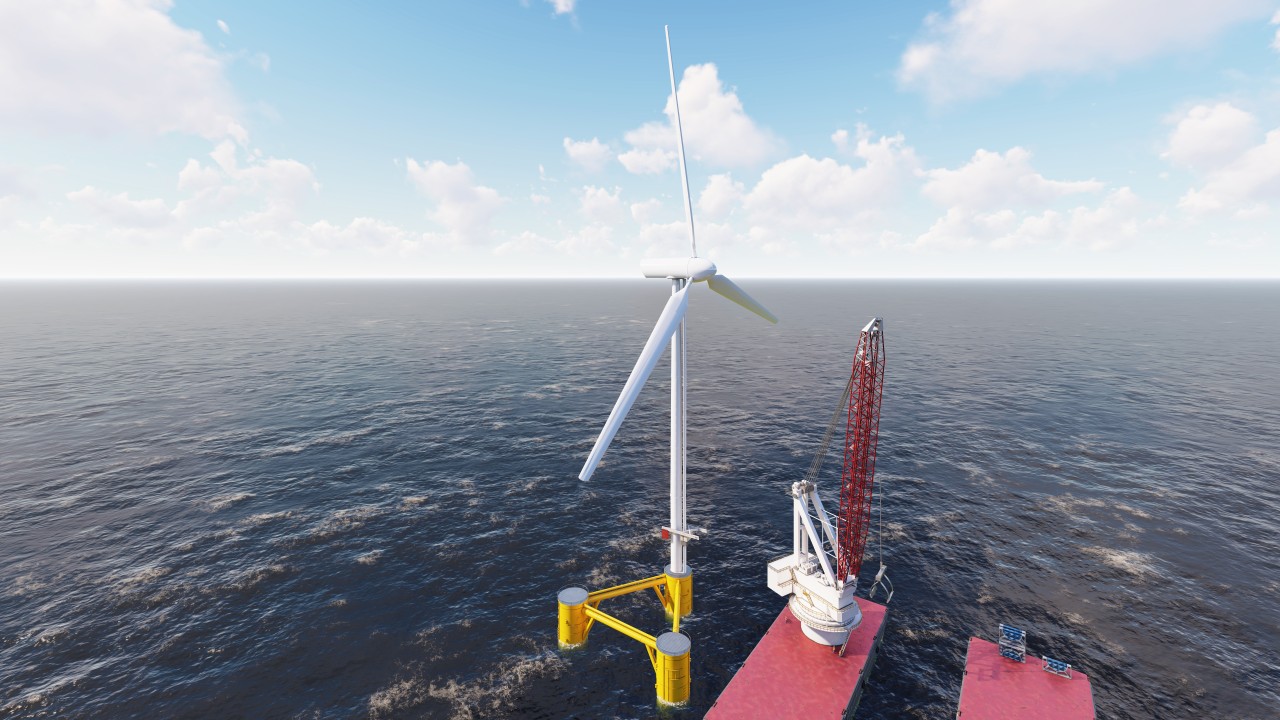
As the global offshore wind industry shifts toward floating technologies, developers are encountering significant challenges—particularly at the port installation stage. With next-generation turbines reaching capacities of 15 MW and beyond, traditional infrastructure is struggling to keep pace. CLS Wind is addressing this bottleneck head-on with a pioneering, crane-reducing system designed to improve port efficiency, reduce costs, and dramatically accelerate project timelines.
Tackling One of Floating Wind’s Largest Bottlenecks
The deployment of floating offshore wind (FOW) farms faces two primary logistical challenges:
- The installation of large wind turbine generators (WTGs) at port.
- The replacement or repair of major components at sea, often requiring towing the floater back to shore.
CLS Wind, founded in 2021, has developed a system that directly addresses the first challenge—port installation—while laying the foundation for streamlined offshore maintenance in the future.
At the core of the CLS Wind system is a patented self-erecting solution based on proven jack-up leg technology. These legs, known for lifting over 10,000 tons in offshore rig environments, are combined with a stable elevating platform, counterweight systems, and remote-controlled automation to lift wind turbine components with greater precision and safety.
Engineering Simplicity with Universal Compatibility
One of the system’s greatest advantages is its universal compatibility. It can be deployed across any turbine brand without requiring tower modifications. This means it is not tied to any specific OEM, offering the industry a flexible solution that dramatically reduces reliance on rare and expensive high-capacity ring cranes.
The process is straightforward:
- The turbine component is loaded onto the elevating platform.
- The platform raises it vertically to the installation height.
- The component is then moved horizontally into place and bolted down per standard procedure.
- The process is repeated for blades, using a patented adapter for seamless integration.
Validated for Floating Offshore Applications
In a recent third-party study, a leading UK engineering consultancy confirmed the feasibility of CLS Wind’s system for floating offshore projects. Using real project data from a 15 MW WTG on a three-column semi-submersible structure, the study demonstrated how the system can be applied to advanced floating technologies similar to those deployed at Kincardine and WindFloat Atlantic.
Importantly, CLS Wind’s solution works across all common floater types—semi-submersible, spar, tension-leg platforms, and barges—so long as a conventional wind tower is used. This flexibility has the potential to redefine port-side integration strategies across the floating wind sector.
Revolutionising Port Installations
Ports are critical to offshore wind logistics, but many are not equipped to handle turbines in the 15–25 MW range. Current installations require cranes capable of lifting over 600 tons to heights exceeding 120 metres—equipment that is expensive, scarce, and often difficult to mobilise.
CLS Wind offers three main installation options:
1. Base Case: Ring Cranes
- Requires 6,000-ton cranes
- Substantial quayside reinforcement
- Land-intensive (approx. 2.5 acres)
- Highly disrupted port flow
- One unit per week installation rate
2. Option 1: Gantry Cranes + CLS Wind System
- Uses standard 1,000-ton gantry cranes
- Minimal port modification
- Maintains port flow
- Multiple turbines installed per week (2–10)
- 50%+ cost savings compared to ring cranes
3. Option 2: Crawler Cranes + CLS Wind System
- Uses mobile heavy-lift crawler cranes
- Minimal disruption or land requirements
- Multiple turbines installed per week (1–5)
- 75%+ cost savings compared to ring cranes
Installation Speed and Cost Efficiency
In North Sea conditions, where a construction season lasts 20–24 weeks, using conventional methods would delay wind farm completion across multiple years. The CLS Wind system enables multiple simultaneous installations, significantly improving the assembly rate and reducing total project duration.
Direct benefits include:
- 2x to 10x increase in installation throughput
- 50% to 75% reduction in cranage costs
- Less port reinforcement and fewer land constraints
- Seamless integration into seasonal port operations
Flexibility for the Future
The system’s modular design ensures reusability for O&M activities, expanding its value beyond initial installation. Its adaptability allows ports to support growing turbine sizes without further infrastructure overhaul.
Additionally, by stabilising components during lift and eliminating the pendulum effect, the system allows for operations in higher wind conditions—reducing weather-related delays.
The Road Ahead
Projects like WindFloat Atlantic, Kincardine, and Hywind Tampen have already highlighted the logistical barriers facing FOW deployments. CLS Wind is currently exploring how its system can replace traditional methods for assembling a 15 MW turbine at port, with the aim of simplifying operations, cutting costs, and accelerating offshore wind development timelines.
With global interest in floating offshore wind growing, and over 100 substructure designs in the pipeline, CLS Wind’s scalable, efficient, and cost-effective solution arrives at a critical moment.
Conclusion: Transforming Floating Wind Port Economics
Floating offshore wind can only scale with new thinking around logistics and infrastructure. CLS Wind’s system directly addresses one of the biggest hurdles—efficient port assembly of next-generation turbines—while reducing risk, lowering costs, and enhancing operational flexibility.
By enabling faster, safer, and more flexible installations, CLS Wind is not only streamlining floating wind deployment—it is redefining what’s possible.
Learn more: www.clswind.com