The commercial solar market across the UK and Europe has matured rapidly over the past decade, delivering robust financial returns through reduced grid dependency and sustainable cost savings. However, as energy markets become more complex and network constraints tighten, thousands of existing installations are operating far below their full economic and technical potential.
The underlying vulnerability of these older configurations can be summarized as generation without control. In this changing landscape, battery energy storage systems (BESS) represent the critical next step, transforming passive solar arrays into actively managed, dispatchable energy assets.
Exploring the value gap in existing commercial PV systems
Many legacy commercial solar installations were designed around the straightforward principle of maximising generation to offset immediate onsite demand, a model that leaves significant value untapped under modern market conditions. As solar penetration increases across the grid, simply pushing unmanaged power back into national networks is no longer a viable long-term strategy.
- Rising export limitations: Distribution network operators are increasingly enforcing strict export limits, meaning excess midday generation is either exported at low value or completely curtailed via export limitation schemes.
- Exposure to volatile pricing: Without localised storage, commercial entities must sell their surplus electricity during low-rate peak solar hours while remaining fully exposed to expensive peak-tariff periods when the sun goes down.
- Massive unoptimised asset base: As of 2025, the UK alone carries over 20 GW of installed solar capacity, with the commercial and industrial (C&I) sector accounting for an estimated 45% of that total volume.
- The shift to flexibility over volume: Thousands of commercial systems installed over the last decade are operating in an environment they were not designed for, making operational flexibility the definitive metric for future profitability.
Key technical drivers behind commercial BESS adoption
Integrating battery energy storage fundamentally changes how a commercial facility interacts with the broader electricity ecosystem. Rather than being entirely dependent on solar production profiles or real-time utility pricing, businesses can use intelligent controls to dispatch energy exactly when it delivers maximum value.
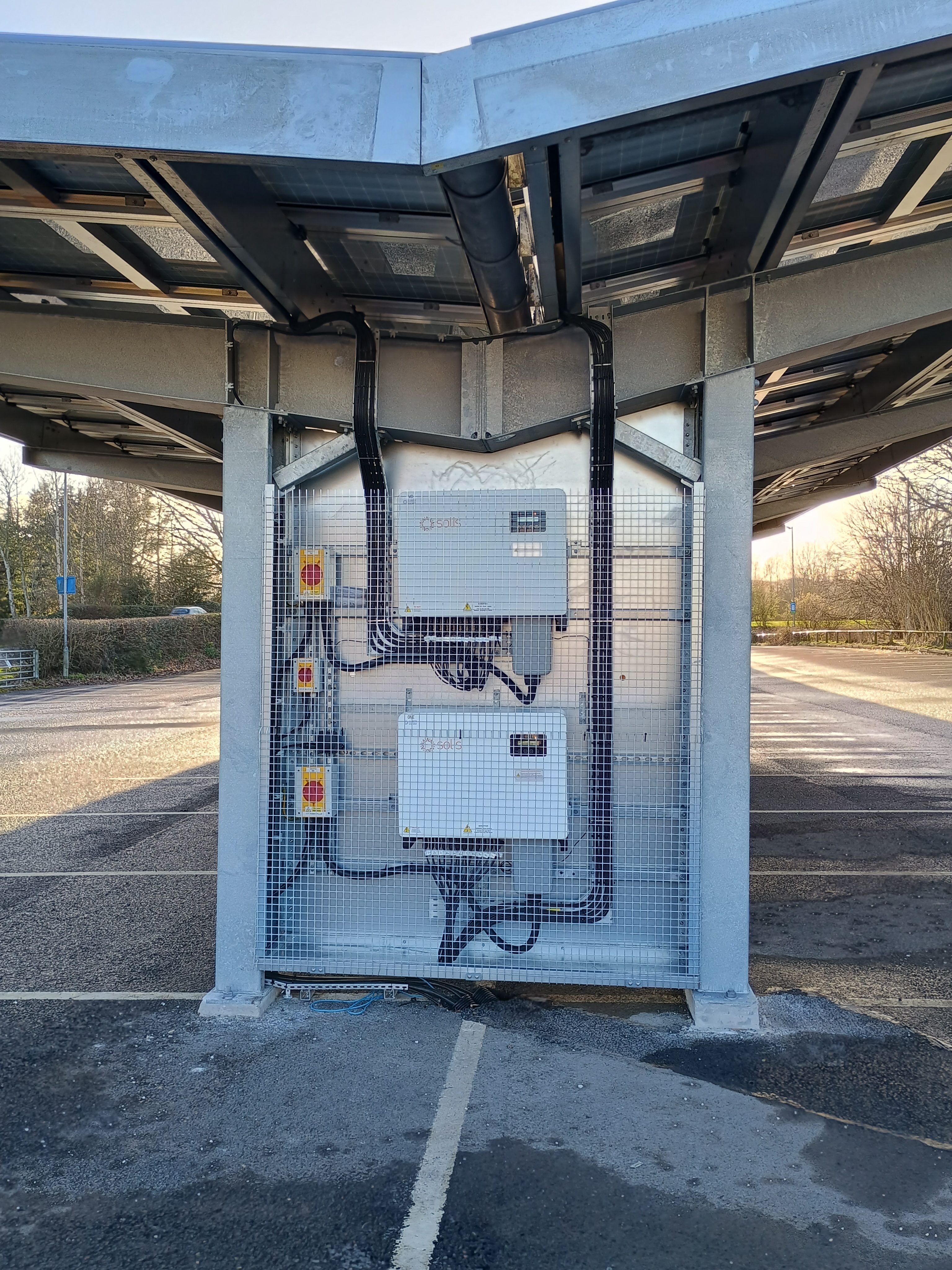
- Active peak demand shaving: Battery systems integrated with automated energy management controls, such as the SolisAi platform, respond dynamically to localised site loads to discharge during short-duration demand spikes, successfully lowering maximum import capacity (kVA) charges.
- Maximising onsite solar utilisation: Localised storage provides an immediate buffer for surplus PV generation, allowing businesses to witness a 20% to 40% absolute increase in on-site solar use while reducing reliance on grid imports.
- Time-of-use tariff optimisation: By connecting hardware to a smart EMS, commercial batteries can be scheduled to charge during low-cost or negative price intervals and discharge during peak grid pricing, shielding intensive processes from wholesale market volatility.
- Native hardware compatibility: Using technology from specialised manufacturers like Solis ensures native inverter-battery compatibility, providing engineers with a unified monitoring platform that minimizes system design complexity.
Real-world application examples and retrofitting considerations
Transitioning an enterprise from standalone solar generation to a fully integrated energy architecture delivers immediate economic advantages across distinct commercial sectors. However, achieving maximum lifecycle returns depends on comprehensive technical evaluations regarding inverter compatibility and load profiles.
- Dampening variable manufacturing loads: Medium-sized factories running heavy machinery regularly experience intense, abrupt demand surges during active production cycles, which can be smoothly mitigated through automated battery load-shifting.
- Logistics hubs and EV fleet scaling: Distribution centres with large rooftop footprints can store their midday solar surplus and smoothly redirect that clean power into high-capacity electric vehicle (EV) charging infrastructure.
- Satisfying strict corporate ESG targets: By increasing the volume of renewable energy consumed directly onsite, corporations can lower their Scope 2 emissions and ensure seamless alignment with international sustainability reporting frameworks.
- Natural evolution of existing infrastructure: Experienced installation firms, such as the UK's ZLC Energy under Managing Director Mark Smith, emphasise that retrofitting BESS onto existing arrays allows installers to unlock substantial value for clients without needing to rebuild projects from scratch.
How is your asset management team using commercial BESS to mitigate peak demand charges and manage grid connection constraints? Share your thoughts in the comments below.
Looking for the full technical breakdown? To examine the complete product specifications of Solis energy storage solutions and review recent C&I retrofit case studies, visit the official Solis Inverters website: https://pes.eu.com/exclusive-articles/unlocking-the-next-phase-of-commercial-solar