As offshore wind turbines become larger, attention often focuses on foundations below the waterline. Above the surface, however, the tower performs an equally important structural role, carrying the nacelle and rotor, absorbing dynamic loads and connecting the turbine to its foundation.
For heavy plate producer NLMK DanSteel, increasing turbine dimensions are placing greater emphasis on consistent steel quality, suitable plate dimensions and reliable delivery to tower fabricators.
A steel-intensive structure
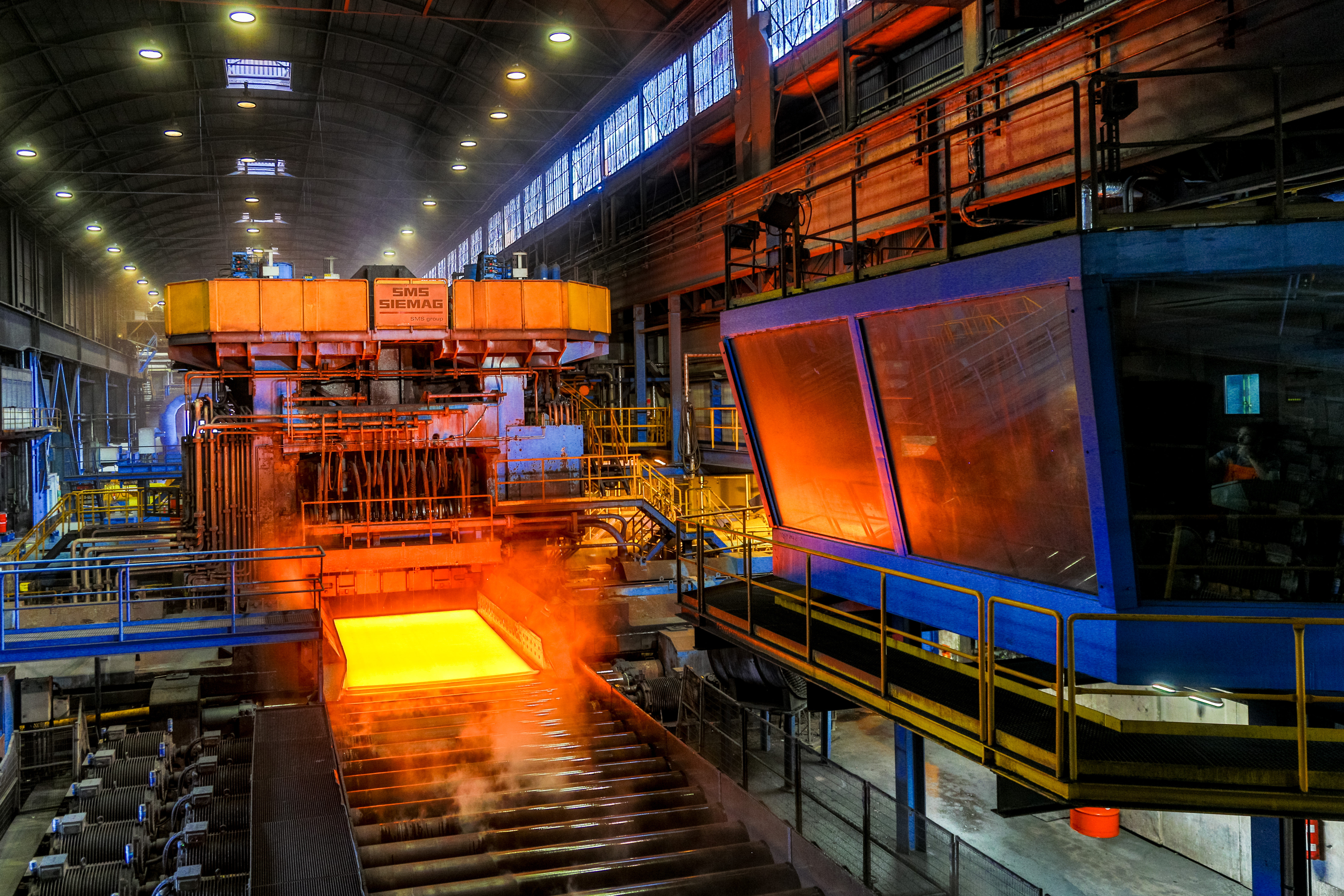
A tower for a modern 15 MW offshore turbine can contain around 750 to 800 tonnes of steel. Its heavy plates must pass through a tightly controlled production and fabrication process, including heating to approximately 1,100 to 1,200 °C, hot rolling, heat treatment where required, cold forming, welding and coating.
Current offshore towers largely use established structural steels, including CE-marked EN 10025 S355 grades in different delivery conditions depending on project requirements.
Although towers are more standardised than foundations, manufacturing remains demanding. Fabricators need repeatable quality and a reliable flow of material to keep production lines operating efficiently.
Why plate dimensions matter
One practical challenge is supplying plates that match increasingly large tower sections.
New offshore tower designs can require plates around 26 m long and weighing up to 30 tonnes. NLMK DanSteel says its ability to supply full-length plates can remove the need for fabricators to join shorter plates before they enter the main manufacturing process.
Avoiding this additional joint welding can reduce:
- Material handling
- Welding and inspection requirements
- Production planning
- Intermediate operations
- Time before tower fabrication begins
Pavel Kolieda, Wind Segment Senior Commercial Manager at NLMK DanSteel, says fabricators generally prefer full-length plates because they can move more directly into production.
The company’s own harbour also supports transport of large-format plates to offshore wind manufacturing regions across Europe.
Capacity beyond typical tower requirements
For standard structural steels such as S355, NLMK DanSteel can produce plates from 5 mm to 256 mm thick and up to 4,000 mm wide.
These dimensions extend beyond typical offshore tower requirements, giving fabricators additional flexibility for larger or more demanding structures.
Heavy plate manufacturing depends on an industrial production environment where dimensional consistency and repeatability must be maintained across high-volume production.
NLMK DanSteel’s capabilities extend beyond towers to offshore foundations. Kolieda argues that considering the complete structure, from the foundation below the waterline to the tower above it, gives the steel producer a broader understanding of offshore wind requirements.
Reliability beyond the steel itself
For fabricators, material performance is only one part of the requirement. Plates must also arrive in the correct dimensions, with appropriate documentation and at the required point in the production schedule.
Eugene Goli-Oglu, Head of Product Development, Technology and Technical Sales Support at NLMK DanSteel, describes reliability and consistent quality as central to the company’s offer. Technical support, commercial coordination and logistics therefore form part of the wider service around the steel.
Lower-carbon steel is also becoming a developing requirement. Through NLMK Europe, the company is preparing options that include electric arc furnace (EAF) production routes at NLMK Verona when projects require lower-emission heavy plate.
As offshore turbines become taller, tower production will depend not simply on producing more steel, but on delivering the dimensions, consistency and logistics needed for serial manufacturing.
For tower fabricators, simplifying that material flow could become increasingly important as offshore wind projects demand larger structures and tighter production schedules.
For the complete Industrial Insight feature from NLMK DanSteel on heavy plate production, full-length tower plates and future offshore wind structures, visit PES Wind: https://pes.eu.com/exclusive-articles/built-to-stand-tall-the-steel-behind-offshore-wind-towers




-1.jpg)