For decades, reducing the levelised cost of electricity (LCoE) from wind has largely meant building taller towers and longer blades. Chanan Herbet, Founder and CTO of SKYREED, argues that the physical and logistical limits of this approach are becoming increasingly difficult to ignore.
His alternative is the harmonic oscillatory airfoil turbine (HOAT), which replaces continuous rotary motion with an oscillating blade system. Herbet believes this different geometry could influence manufacturing, aerodynamics, offshore deployment and ultimately the economics of renewable generation.
Moving beyond conventional rotary motion
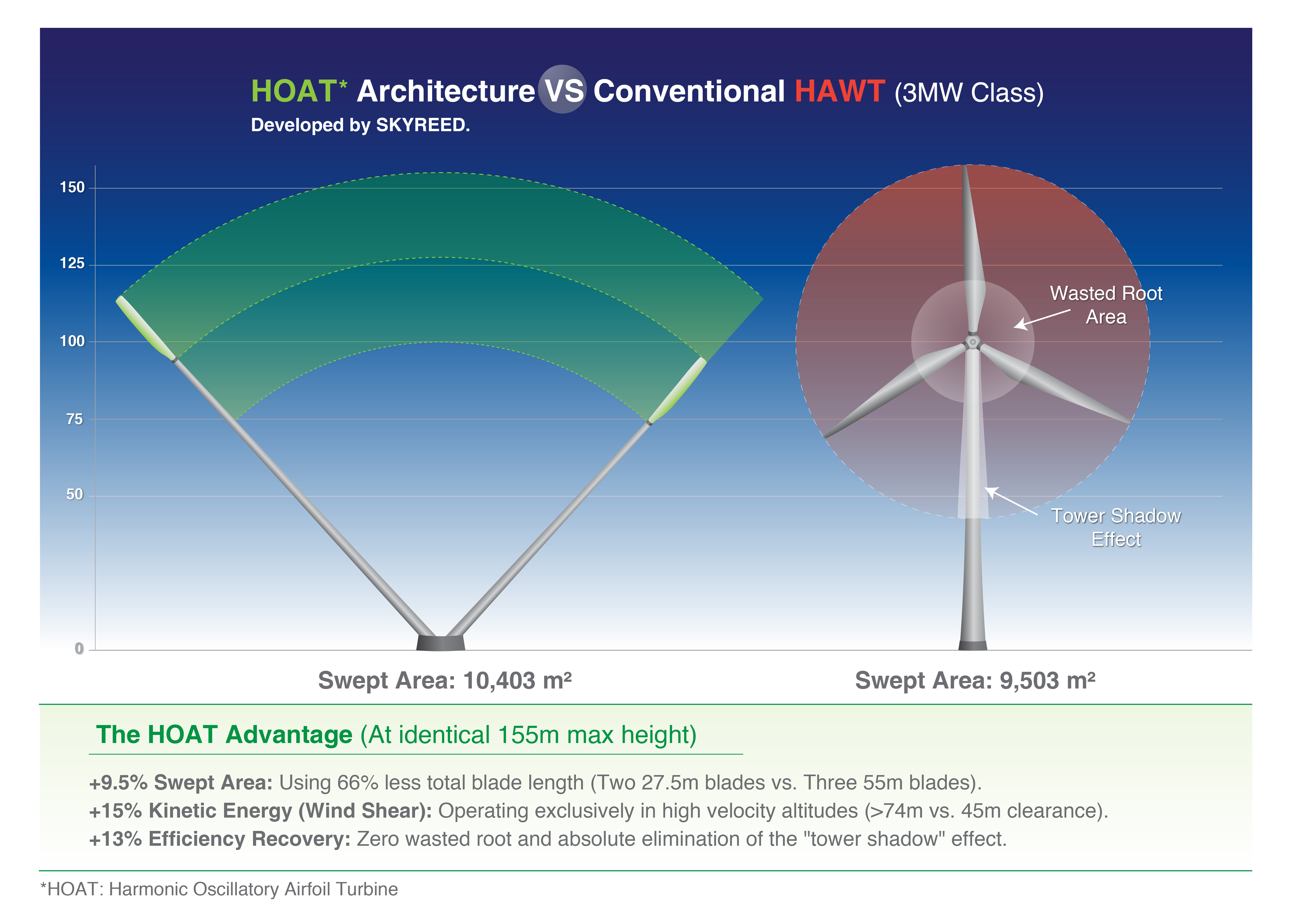
Conventional horizontal-axis wind turbines (HAWTs) require longer blades to increase swept area. According to Herbet, this increases structural loads while demanding large composite components, specialist transport and heavy installation equipment.
HOAT takes a different approach. A lightweight aerodynamic shell is mounted on an internal support mast and moves through an arc of approximately 80 degrees rather than rotating through 360 degrees.
At the end of each stroke, the shell reverses its orientation and begins the return movement. The concept is intended to create continuous lift while allowing comparatively short blades to cover a large effective swept area.
Herbet identifies several potential engineering advantages:
- Modular blades that can be transported in standard containers
- Heavy machinery positioned near the base to reduce the bending moment
- A more uniform aerodynamic speed across the blade span
- Higher minimum blade altitude and no passage behind a central tower
SKYREED claims that operating in higher wind layers could allow an equivalent swept area to capture up to 10 to 15% more kinetic energy. This remains a company-specific performance claim and would require validation under relevant operating conditions.
Using the array as part of the aerodynamic system
The second part of the concept is the Synergistic Cascading Array (SCA).
Conventional turbines must be separated to reduce interference from wakes. By contrast, Herbet proposes deliberately positioning HOAT units so that interactions between them contribute to energy capture.
The design relies on two effects. The Venturi effect uses spacing between units to accelerate bypass air towards downstream turbines, while what SKYREED calls the Ramp effect directs moving air towards the blades’ preferred operating zones.
Rather than treating wake interaction purely as a loss, the aim is to use array geometry as an active part of the aerodynamic system.
Taking the concept underwater
Herbet sees an even greater opportunity in adapting the architecture to tidal and ocean-current generation.
In the proposed marine configuration, only the oscillating blades are submerged, while the power take-off (PTO) and generator remain above the water. This is intended to improve accessibility and reduce exposure of major components to saltwater.
Because water is more than 800 times denser than air, ocean currents contain substantial kinetic energy. SKYREED argues that dense SCA layouts could concentrate significant generating capacity on a single floating platform, spreading anchoring and export-cable costs across a larger energy output.
The company also proposes tailoring blade length and sweep angle to target energy-dense layers of water while maintaining seabed clearance.
From ocean currents to continuous generation
Herbet’s longer-term vision extends beyond turbine design. Because ocean currents can provide more predictable generation than wind or solar, he believes HOAT-based marine systems could contribute to continuous renewable power without depending as heavily on large battery energy storage systems.
Potential applications include:
- Floating data centres supplied directly offshore
- Seawater desalination
- Green ammonia production
- Offshore bunkering hubs positioned along shipping routes
SKYREED also acknowledges the technical questions associated with oscillatory systems, including fatigue, energy absorption and transmission durability. Herbet says the company is addressing these through a low centre of gravity, hybrid-material support masts and its Kinematic Decoupling Drive (KDD).
The proposition is ambitious, but the underlying argument is clear: rather than continuing to increase the dimensions of conventional turbines, Herbet believes renewable energy should also reconsider the geometry and motion used to capture energy in the first place.
For the full PES Wind feature from SKYREED on HOAT architecture, Synergistic Cascading Arrays and the potential application of oscillatory systems to wind and ocean-current generation, visit: https://pes.eu.com/exclusive-articles/the-glass-ceiling-of-the-energy-industry