The ever-evolving renewable energy landscape demands solar tracking systems to meet new regulatory requirements and engineering challenges. Increasingly frequent extreme weather and terrain flexibility are the most complex and pressing design concerns. Over the last 15 years, IDEEMATEC’s specialty has been following challenging terrain, building the design and engineering expertise that made L:TEC the industry benchmark.
Recent extreme weather events globally have shown that high winds and hail events cause catastrophic damage to unprepared solar installations. IDEEMATEC’s THOR-Stow hail damage prevention strategy is the next level of added protection when paired with the rock-solid stability of the L:TEC tracker platform. These software and hardware innovations create the most comprehensive safety net for the substantial investments made in solar parks.
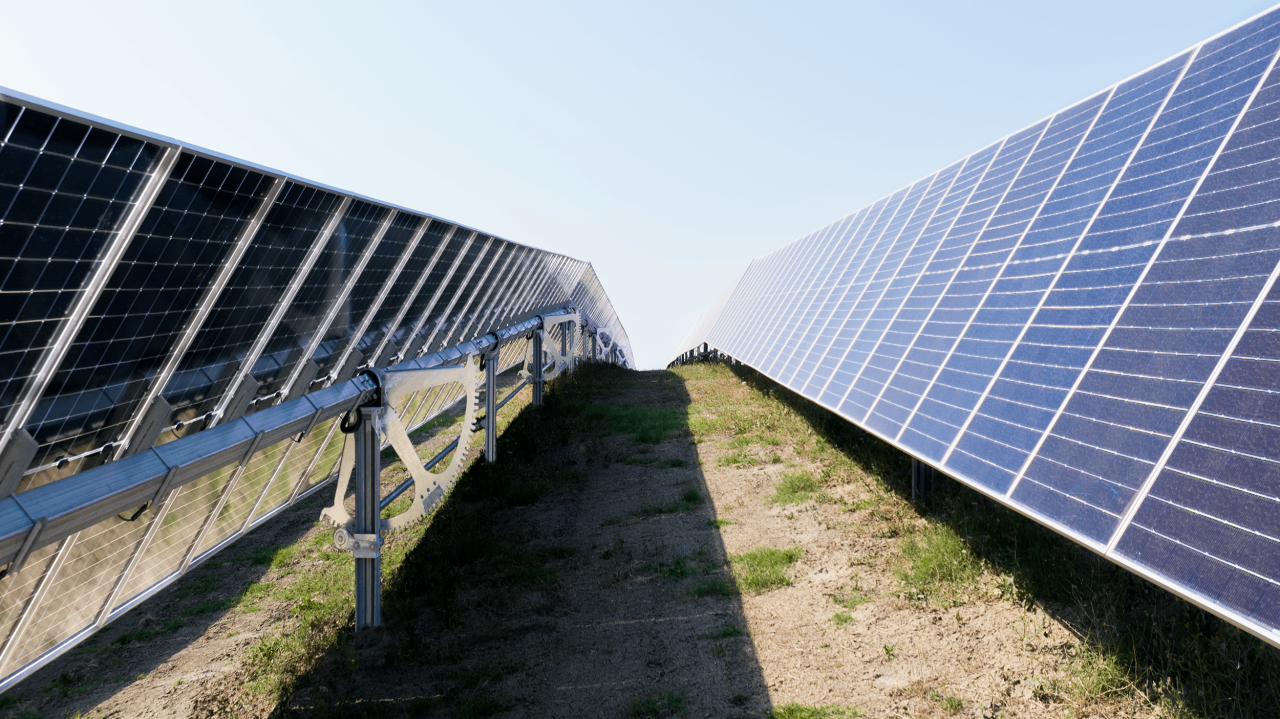
The L:TEC 1P is continuously tested by CCP Wind Engineering Consultants for aeroelastic stability. In recent tests, a special configuration of the L:TEC 1P tracker proved its stability in the wind tunnel, reaching speeds of 400 kph. This industry-first stability comes from the combination of IDEEMATEC’s decoupled drive and configurable multiple locking points. High-wind regions have now become prime locations for its trackers.
Advanced wind tunnel testing
IDEEMATEC conducted a comprehensive aeroelastic wind tunnel study with CPP in Sydney, Australia. The objective was to methodically analyze the L:TEC 1P tracker, equipped with its patented multi-locking technology, under extreme wind conditions.
Partnering with CPP ensures access to top-tier aeroelastic testing facilities and adherence to the highest standards of wind tunnel testing.
This proactive design testing continues to enhance the stability and performance of L:TEC solar trackers, driving the industry forward. The tests assessed how the tracker resists torsional instability related to the tested tracker configuration. The verified results were groundbreaking.
Testing a multilocked tracker configuration of the L:TEC 1P showed that it remains completely stable up to wind speeds of 400 kph (3-s gust at 10m) when in the stow position. This stability allows engineers to configure the tracker 1P for any wind region worldwide.
Wind regions with low and mid-wind speeds use a standard number of locking points; high-wind area trackers will be equipped with additional locking points to maintain stability.
The incredible stability of the technology marks a significant milestone for the solar tracker industry, making the L:TEC 1P the world’s most stable tracker.
This 400 kph stability milestone is the product of IDEEMATEC’s constant aeroelastic testing with CPP and innovative design iterations. Again, this proves its commitment to staying ahead of the curve.
Setting wind speed benchmarks
In the design of solar tracker systems, understanding the impact of wind is crucial. Trackers need to be robust, not just to sustain everyday weather but also to withstand the extreme conditions they will face during their operational lifetime.
The innovative L:TEC 1P endurance in wind speeds reaching up to 400 kph during 3-second gusts is second only to the highest wind speed ever recorded, a staggering 406 kph recorded at Barrow Island, Australia, during Tropical Cyclone Olivia. This incredible record was documented and peer-reviewed in the study ‘Documentation and verification of the world extreme wind gust record: 113.3 m/s on Barrow Island, Australia, during passage of tropical cyclone Olivia; J. Courtney et al.; 2012; Australian Meteorological and Oceanographic Journal 62’.
For example, the L:TEC 1P is suitable for one of the highest wind regions across the US (Florida), where the maximum design wind speed according to ASCE 7-22 is 320 kph (3s gust at 10m, highest risk category IV). Typically, US. regulations require project designs to meet wind speed risk category I or even category II. The L:TEC 1P can be perfectly configured to reach the US market’s minimum design wind speed criteria.
On the other side of the globe, Australian regulation AS/NZS 1170.2:2021 requires tracker operational envelopes to extend up to 327 kph (0.2s gusts, importance level 4). In Australia, the Importance level used for the design of solar trackers is usually 1 or 2. With verified stability up to 400 kph (3-sec gusts), the L:TEC 1P surpasses regulatory requirements, providing unmatched performance and reliability.
The L:TEC 1P’s record-setting stability makes it the perfect fit for solar installations worldwide, regardless of local wind conditions. The future demands flexible and reliable renewable energy solutions. IDEEMATEC’s L:TEC platform inspires confidence in the resilience of renewable infrastructures against increasingly unpredictable global weather patterns.
Terrain flexibility
IDEEMATEC’s approach to adaptable solar tracker design blends German-engineered precision with practical modularity. This capability means that L:TEC suits terrain no other tracker can handle. Designs are easily adapted to any grade up to 36% N-S or E-W by incorporating standardized on-hand components.
Timing isn’t just a factor for any solar construction project, it’s the currency. Earthworks are a significant expense and can often create challenges in project planning and execution. L:TEC offers a streamlined solution for diverse landscapes, mitigating the need for extensive cut and fill. Excavation opens the door for considerable delays and requires repeated soil testing. Using short tables, the tracker reduces earthworks requirements by up to 400%. IDEEMATEC’s design significantly decreases delays, translating directly into cost savings.
L:TEC’s decoupled drive system is the key to accurate and repeatable positioning on challenging terrain. Utilizing a single drive system and controller, L:TEC is configurable for up to eight string-conform tables up to 260 m in length. This design efficiency simplifies the construction process, reducing costs. Shorter tracker designs can only have three strings per drive unit, using up to four times more motors for comparable string lengths. These designs are susceptible to inaccuracy due to twisting along the length of the torque tube.
Simplicity in design doesn’t mean compromising on stability. Many current designs need costly additional motors, dampers, and main carrier reinforcements to maintain stability. L:TEC requires the fewest components for optimal stability, significantly reducing installation costs and long-term O&M expenses.
IDEEMATEC’s L:TEC platform leads the market in tracker stability and flexibility.
The tracker’s proven ability to handle wind speeds up to 400 kph and the addition of the THOR-Stow system highlights the ongoing mission to lead the pack in solar tracker innovation.
Its integration with SCADA systems for real-time responses to severe weather and the platform’s unique ability to adapt to difficult terrains while cutting down on extensive groundwork offers a double win, better economic efficiency and quicker project rollouts.
As unpredictable weather becomes the new normal, the stability and reliability of the L:TEC platform is the premiere choice for power providers around the globe.
By building confidence among investors and safeguarding significant investments against environmental extremes, IDEEMATEC is moving the industry forward.
The durability, adaptability, and reliability of its technology are shaping the future of renewable energy infrastructure.
For the first time, terrain, high winds, and extreme weather are no longer obstacles. The L:TEC platform offers stability and safety, allowing solar plant construction where needed with confidence.