In the rapidly expanding world of photovoltaics, standard solutions often fall short. Unique site conditions, structural limitations, and logistical hurdles can make projects seem impossible. In fact, a recent survey revealed that over half of solar installers have declined orders due to complex planning or a lack of suitable mounting options.
However, two recent projects demonstrate that even the most challenging installations can be mastered through smart planning, adaptable components, expert collaboration, and sometimes, a little high-flying creativity. These examples showcase how thinking outside the box, and often avoiding conventional scaffolding, can deliver impressive PV systems against the odds.
Case Study 1: High-Altitude Innovation on a Stadium Roof
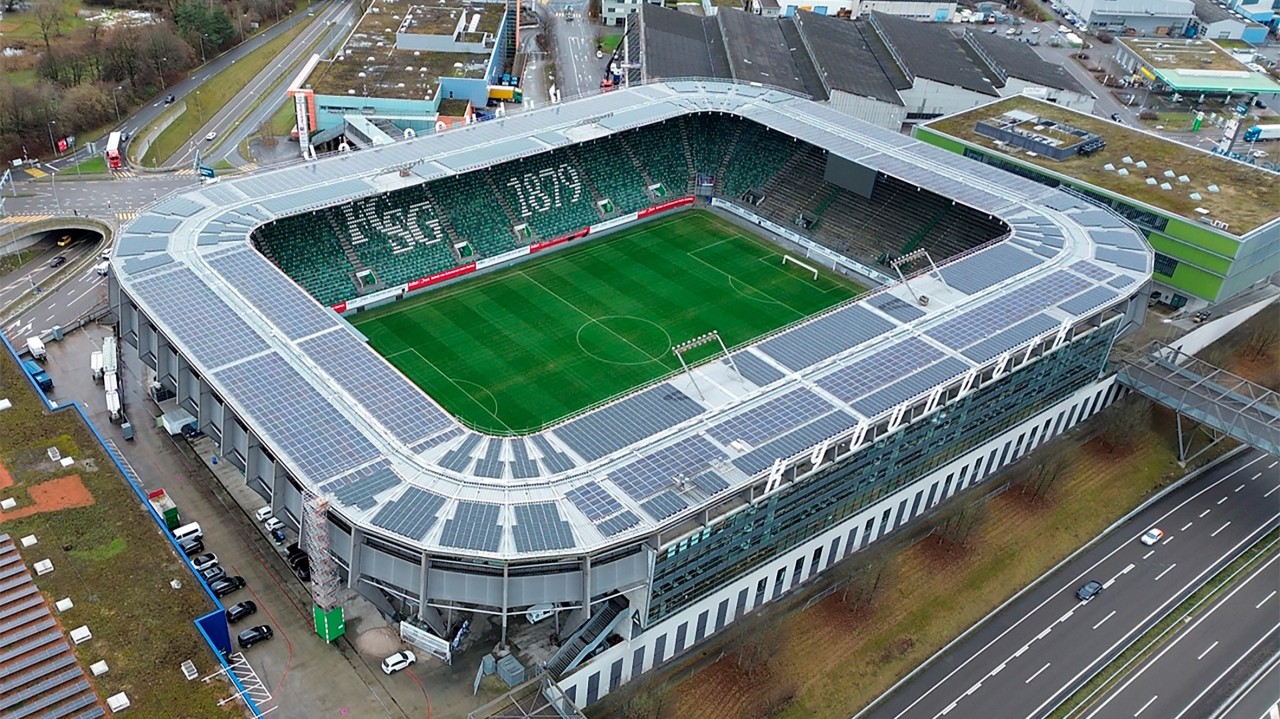
The Challenge: Expanding the existing PV system on the Kybunpark football stadium in Switzerland presented multiple hurdles.
- Location: At 652 meters above sea level, it faced significant snow loads ($2.8~kN/m^{2}$) and higher wind loads.
- Structure: The grandstand roof wasn't designed for additional loads, ruling out traditional mounting.
- Roof Type: The trapezoidal sheet metal roofing, including rounded corners, prevented fastening in the water-carrying deep beads or using standard solar fasteners.
The Solution: Close collaboration between manufacturers, installers, and structural engineers led to an innovative approach.
- Direct Substructure Anchoring: The system was fixed directly to the roof's I-beam substructure using K2 SpliceFoot adapters. Special self-drilling screws, coated to prevent corrosion and eliminate pre-drilling, passed through the high crests of the trapezoidal sheet metal into the I-beams. Additional self-tapping screws secured the fastener to the sheet metal itself.
- Waterproofing: A polyisobutylene sealing layer ensured a durable, waterproof seal at penetration points.
- Load Distribution: This method transferred loads directly into the supporting structure, avoiding stress on the roof covering.
- Bridging Spans: To cover large spans of around 4 meters between purlins, the robust K2 SolidRail XL, capable of spanning up to 7 meters, was used as a support rail, mounted on the K2 SingleRail 50 base rail.
The Logistics: Conventional cranes were not feasible or cost-effective. Instead, a helicopter team was used to transport components directly to installation points on the roof. This highly efficient method, common near ski resorts, involved short lifting times (1-1.5 minutes per load) and precise planning to adhere to the helicopter's maximum load capacity. The entire operation was completed in one morning.
The Outcome: A safe, structurally validated 572 kWp system using 1,285 modules was successfully installed. Since February 2025, it has generated over one million kWh annually, used partly on-site and partly fed into the city grid.
Case Study 2: Doubly Effective – Solar Power Meets Advertising Façade
The Challenge: A commercial building owner wanted to combine façade advertising space with solar energy production. The PV system couldn't be mounted directly on the building façade but needed to be installed on a separate steel framework surrounding an external staircase, which had to remain accessible. Aesthetics were paramount due to a large central advertising banner.
The Solution: A pre-assembled structure featuring vertically positioned K2 SolidRail Alpin mounting rails was employed.
- Custom Mounting: Custom-made L-brackets, engineered by a structural specialist, fastened the rails to the square steel tubes of the suspended frame using special steel dowels. Hammerhead screws provided security against lifting forces.
- Anti-Slip Security: Since hammerhead screws have limited vertical resistance, an additional standard anti-slip device (typically used with K2 WallPV CarrierRail) was attached to prevent downward slippage.
- Seamless Aesthetics: Modules were inserted into pre-mounted K2 InsertionRails, offering a time-saving alternative to clamps and creating a visually uniform surface interrupted only by necessary thermal expansion gaps.
The Logistics: The entire installation was carried out efficiently using a large lifting platform, often the most effective method for façade work where securing scaffolding can be difficult. Careful pre-planning was essential.
The Outcome: 128 modules were installed, adding further solar generation to the existing ~100 kWp rooftop system while seamlessly integrating the prominent advertising space.
Mastering Complexity Through Flexibility and Expertise
These projects underscore that success in complex PV installations hinges on several key factors:
- Smart Budgeting & Planning: Effective cost management and meticulous pre-planning are crucial.
- Proven, Adaptable Systems: Modular mounting systems provide the flexibility needed for custom solutions.
- Expert Collaboration: Close cooperation between manufacturers, installers, structural engineers, and clients is essential to overcome unique challenges.
- Innovative Logistics: Thinking beyond scaffolding to utilize tools like helicopters and lifting platforms can unlock efficiency and feasibility.
When flexible components meet expert planning and creative execution, even the most demanding conditions can be mastered safely, efficiently, and sustainably.