Under the Joint Offshore Wind Investment Pact signed in Hamburg in January 2026, nine European governments and their transmission system operators (TSOs) pledged to deploy up to 15 GW per year, targeting 300 GW of offshore wind by 2050. However, lead times for high-voltage direct current (HVDC) systems now stretch to eight years or more, and Europe's top three manufacturers carry a collective backlog of roughly €35 billion. Traditional market tracking can no longer keep pace with this tightening supply chain.
Five core trends reshaping the cable market
- The 525 kV technology leap: The historical standard of ±320 kV HVDC grid connections (900 MW) is giving way to ±525 kV cross-linked polyethylene (XLPE) systems that deliver 2,000 MW per system. This 2.2x capacity boost reduces the total number of cable systems needed, but only a few manufacturers can produce cables at this voltage.
- Supplier pricing power: Extreme demand grants massive pricing power to the industry's ‘Big Three’(Prysmian, NKT, and Nexans). For instance, Prysmian reached its 2028 transmission margin target of 18% in 2025, three years ahead of schedule.
- Heavy infrastructure expansion: Suppliers are building highly specialized infrastructure to handle the heavier bend radii and weight of 525 kV systems. NKT is developing the world’s largest offshore cable factory in Sweden with a 200-metre extrusion tower, while teams race to commission next-generation cable-laying vessels.
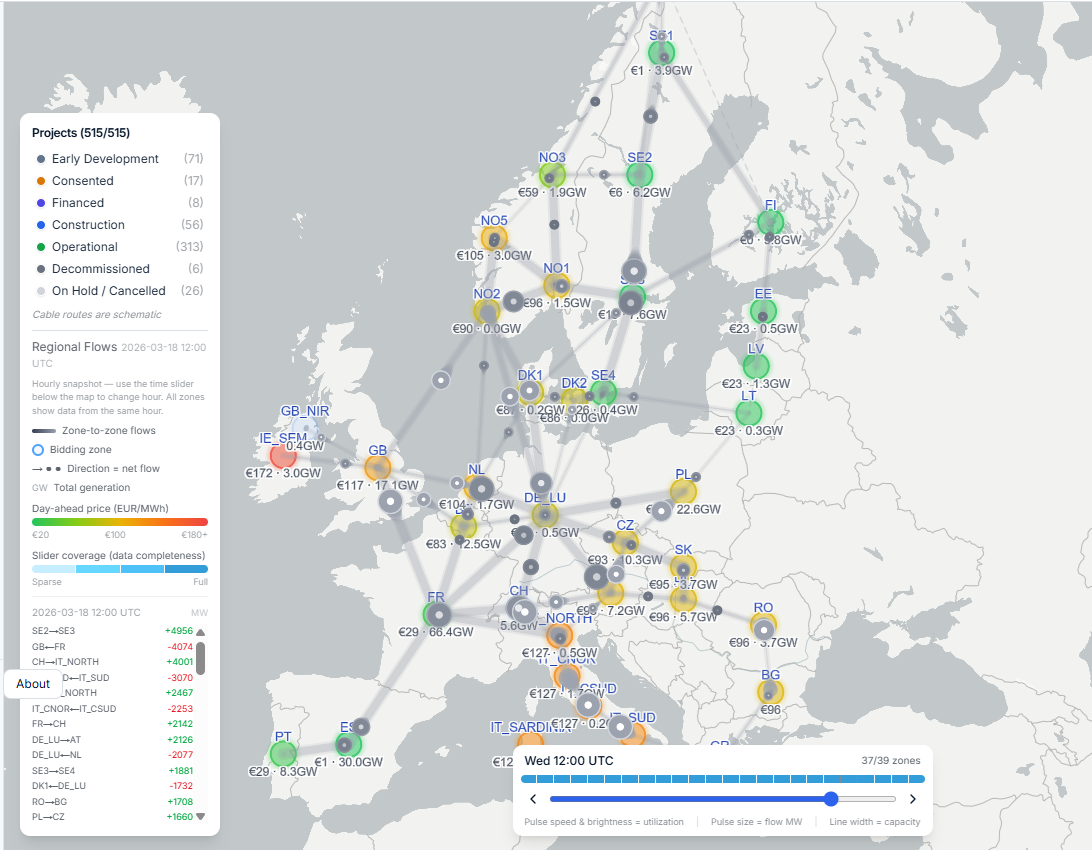
- The transition to meshed grids: European transmission architectures are evolving from radial point-to-point links towards "meshed" grids. Interconnected nodes, such as Germany’s HeideHub or Denmark's Bornholm Energy Island, will act as both collection hubs and multi-terminal interconnectors.
- Onshore corridor competition: Subsea projects directly compete for manufacturing slots with Germany’s massive underground land corridors, such as SuedLink and SuedOstLink, which use subsea-specification HVDC cables to bring North Sea power to southern industrial hubs.
Political headwinds and data fragmentation
While hybrid cross-border interconnectors are highly lucrative, they remain vulnerable to sudden political shifts. Following its September 2025 election, Norway effectively froze new cross-border cable developments until at least 2029 out of concern for domestic electricity price impacts, stalling several planned corridors overnight.
Compounding this is a massive data fragmentation problem caused by entirely different regulatory models:
- The UK uses a competitive, tender-based Offshore Transmission Owner (OFTO) regime.
- Germany and the Netherlands rely on centralized TSO-build-and-own models.
- Norway operates on a developer-full-ownership framework.
A single massive project scatters its information across developer statements, regulator filings, and vendor press releases, meaning no conventional source holds the complete picture.
How AI-driven intelligence is closing the gap
To map this complex ecosystem, the energy industry is turning to AI-powered intelligence systems to continuously scan thousands of unstructured sources. Fully characterizing a single offshore wind grid connection requires tracking over 200 distinct structured variables, ranging from voltage and insulation tech to burial depth and CAPEX estimates.
Modern AI extraction models pull this data automatically. This allows analyst teams to benchmark lead times from final investment decision (FID) to commercial operation, calculate vendor risk indices, and track vessel availability curves. By automated cross-referencing and source-tracing, human experts can spend their time on high-level interpretation rather than manual data entry.
How is your team tracking international grid dependencies and supplier capacity to secure long-term cable supply? Share your thoughts in the comments below.
Looking for the full technical breakdown? To read the complete industrial insight on subsea transmission data frameworks and offshore grid models, visit the original article on the PES Wind website: https://pes.eu.com/exclusive-articles/the-intelligence-gap-why-europes-subsea-power-cable-boom-demands-a-new-approach-to-market-data