PES met with Daniel Flanigan, Chief Marketing & Product Officer at Erthos, to find out more about the simplicity, performance, and economics of earth-mounted solar, and why their technology is poised to upend the utility-scale market.
PES: Hi Daniel, thanks for taking the time to chat with us today. Perhaps we should start with some basic information about Erthos. Why was it founded and what does it do?
Daniel Flanigan: Erthos was founded by Jim Tyler in 2019. Jim came from DEPCOM Power, which he co-founded in 2013, and prior to that he was a VP at First Solar. He has worked in utility-scale solar for nearly 20 years now, which is a long time in our young industry. He had been carrying this idea with him for some time that once module prices decreased below a certain threshold, roughly 40 cents per watt, depending on numerous factors, it would become more cost-effective to eliminate racking and tracking, and all the material and labor costs that come with it, and instead just put the modules flat on the ground. In 2019, he realised that we had largely crossed this threshold, and so Erthos was born.
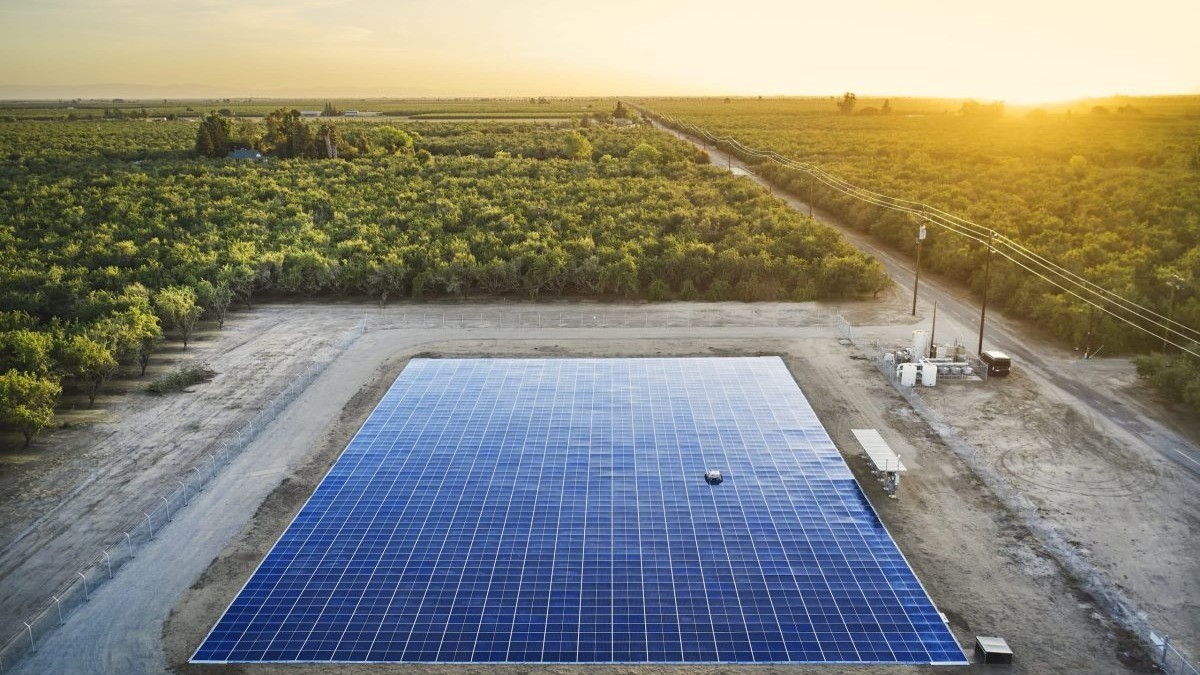
Jim was quickly joined by a team of veteran solar professionals, who together developed the product that we sell today, which we call Earth Mount Solar PV, and is designed for the utility-scale market. In addition to eliminating structural steel from the bill of materials, Earth Mount Solar PV also solves numerous other problems, including design complexity, excessive land use, subsurface risk, mechanical complexity, installation cost, supply chain risk, soiling, and vulnerability to wind.
This year, for the first time ever, the US has seen an increase in the mean levelised cost of energy (LCoE) for utility-scale solar, from $36/MWh to $60/MWh. A huge portion of all systems being built in the US utilise the same mechanical architecture, single-axis trackers. PPA prices are highly competitive and cost variability is minor. This technology mix can’t solve the problem of increasing LCoE, leaving the industry vulnerable to the vicissitudes of macro-economic factors. Earth Mount Solar PV offers a step-function improvement in LCoE, reversing this unfortunate trend.
PES: There’s a reason that 90% of the entire utility-scale solar industry relies on single-axis trackers. If the modules in your system aren’t following the sun, aren’t you losing a lot of efficiency?
DF: That’s why the 40 cents per watt threshold was so important. It’s true that a solar module on a tracker plant generates about 20% more energy per module compared to a solar module laid flat on the ground, as it is in an Earth Mount Solar PV system. However, due to the low cost of solar modules and the high cost of steel, not to mention the labor required to install that steel, and the extra land required to accommodate the row spacing necessitated by elevated trackers. It’s more cost-effective to simply add more solar modules to an earth-mounted system and forgo the racking and tracking altogether. The full cost of an Earth Mount Solar PV system has an LCoE that is approximately 20% lower than that of a single-axis tracker system generating an equivalent amount of energy.
PES: A 20% reduction in the levelised cost of electricity is a huge number. How significantly do you expect that to impact the market?
DF: It’s an enormous number and will have a big impact. For context, in 2005 there were very few single-axis tracker systems operating in the United States. By 2010, they were over 90% of the utility-scale market. They took over the market, basically overnight, because they represented a 5% decrease in the LCoE when compared to fixed-tilt systems. Erthos is offering a LCoE reduction of 20%.
The additional cost of adding solar modules is overcome by the dramatic reduction in balance of plant and labor costs. And because there is no inter-row spacing in an Earth Mount Solar PV system, we can generate the same energy as a tracker plant on just one-half to one-third the land. CAPEX is reduced as a result of this smaller footprint, but OPEX is reduced as well since an Erthos plant is physically much smaller than a conventional tracker system. These and other factors combine to achieve the overall 20% reduction in LCoE, which, it’s worth noting, will only improve as module prices continue to go down.
Cost reductions of this magnitude are rare in any industry; when they do occur, they change entire markets very quickly.
PES: The economics seem both simple and powerful. But what about performance and durability? If you just install modules flat on the ground, aren’t they more susceptible to weather events?
DF: It’s true, there are unique challenges that come with installing modules directly on the earth, but performance and durability are not among them. According to a recent NREL study of 250 solar plants across the US, the average performance index of a utility-scale system is about 93.5%. By contrast, Erthos’s entire commercial portfolio has a performance index of 96.9%.
As for durability, our systems are extraordinarily resilient. Last year, Earth Mount Solar PV achieved a wind rating of 194 miles per hour, easily the highest in the industry, and higher than any hurricane wind speed ever recorded on US soil. It may not be obvious from some of the pictures, but our system is held in place, firmly but flexibly, by mesh cables that pass through the module frames and terminate at concrete perimeter blocks that enclose the array.
As for rain, our systems are designed to handle all the water Mother Nature can throw at them. It’s worth noting that we have four projects operating in California counties that were pounded with record-breaking rains and flooding last winter. Canary Media came out and did a story on one of these sites, and noted how normal it looked. It was completely unaffected, even as the county it’s located in was declaring a state of emergency.
PES: How do you keep the modules clean? I’m imagining they must get incredibly dirty, being so close to the ground.
DF: The answer is ErthBot, our proprietary cleaning robot that lives in a docking station at the edge of each array. Every night, the ErthBot comes out and cleans the modules of debris, dirt, mud, bird droppings, and more. It’s completely autonomous and highly effective. It’s a remarkable robot, and it’s a major contributor to our performance index numbers being so much better than the industry average.
An interesting and telling anecdote is that we have test sites where an Earth Mount Solar PV system is installed next to a single-axis tracker system, and our visitors to these sites never fail to remark how much cleaner our system is than the tracker system next to it. It’s costly and timeconsuming to clean single-axis tracker systems, which are elevated and tilted and spaced apart, whereas cleaning an Erthos system is so trivial that we do it every night without humans.
PES: This has been fascinating. Anything else you’d like to share?
DF: Although it may seem simple to place solar modules on the ground, there’s a lot that goes into doing it right. Soiling, hydrology, wind, energy performance, and thermal performance are some of the key areas addressed successfully by the Erthos approach. It should be noted that systems up to 617 kW have been successfully designed, built, financed, insured, and permitted in five counties in the US, with many more on the way. A major milestone will be the completion of the 100 MW+ Industrial Sun project in Texas, which is currently under contract.
For anyone who still has questions about how our system works, I encourage them to check out our website, which contains key technical white papers on many of the topics introduced above. And if you aren’t following us on LinkedIn, that’s the best way to stay up-to-date with what’s happening at Erthos. Give us a follow and let’s change the world.