The global wind industry is rapidly advancing toward larger turbines with hub heights exceeding 150 meters and rotor diameters nearing 200 meters. In this new era, the ability to measure wind accurately across the entire rotor span is critical for energy yield assessments and long-term investment confidence.
Enter the ZX 300e, the next evolution in wind lidar technology. Building on 15 years of field experience from the ZX 300 platform, this new system brings together proven heritage with cutting-edge validation to offer finance-grade measurements up to 300 meters.
Bridging Heritage and Innovation
The ZX 300e is not just a new product; it is an evolution of the industry's first IEC-classified ground-based lidar. Serial production began over a year ago, meaning units have already been deployed globally, undergoing validation or ready for immediate use. This approach combines the confidence of a mature platform with the advanced capabilities required for modern turbine scales.
Performance Verification: The Data Speaks
A comprehensive program of performance verification campaigns has solidified the ZX 300e’s reliability and accuracy.
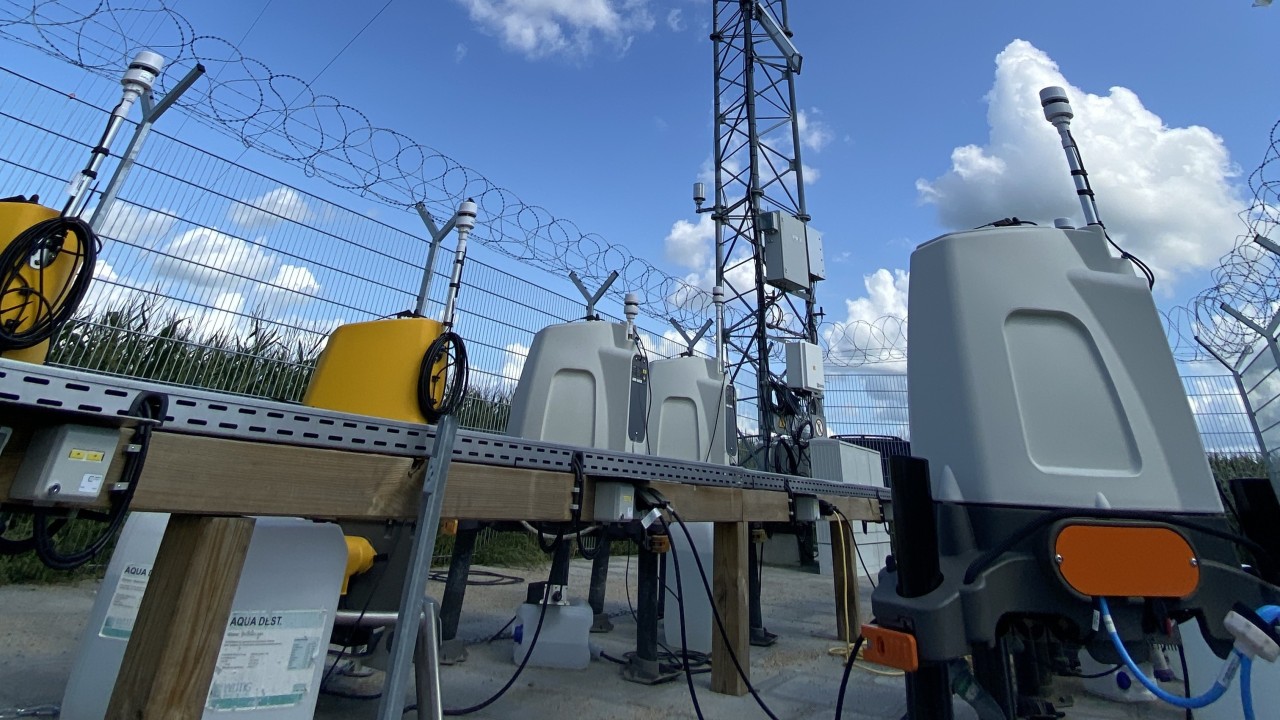
- High-Mast Verification: Extensive comparisons at independent facilities like Hanover and Janneby in Germany, alongside 200m IEC-compliant masts, demonstrated correlation slopes consistently within ±1% and R² values greater than 0.985. Data recovery exceeded 95%, even in high turbulence.
- Fleet-Wide Consistency: At the UK Remote Sensing Test Site, over 25 units were verified using "Midar" technology (mast + vertical-profiling lidar). Results showed exceptional repeatability, with correlation slopes within ±1.1% up to 300m—proving that measurements remain robust well beyond traditional mast heights.
Mastering Complex Parameters
Beyond simple wind speed, the ZX 300e excels in measuring critical parameters essential for turbine design and load assessment.
- Turbulence Intensity (TI): Using the METICE methodology (a machine learning approach), the ZX 300e accurately predicts cup-equivalent TI from 10-minute lidar data. Validated across 17 sites worldwide, it consistently meets industry KPIs, positioning it as a tool suitable for turbine design certification.
- Wind Direction: The system has demonstrated stable, high-accuracy directional performance, crucial for analyzing rapid wind veer events that impact large rotors.
- Complex Terrain: In hilly or forested environments where wind flow is non-homogeneous, the ZX 300e has been validated using CFD conversion methodologies, achieving finance-grade accuracy even in challenging conditions.
A World-First IEC Classification
Complementing its real-world verification, the ZX 300e is the first wind lidar to achieve IEC classification across a full order of magnitude in height range—from 21 to 200 meters. This world-first classification confirms that measurement uncertainty does not increase with hub height, making it suitable for the largest turbines on the market today.
Industry Implications: Faster, Safer, Bankable
For developers, operators, and investors, the implications are significant:
- Faster Development: Reduced reliance on tall met masts lowers campaign costs and improves site safety.
- Operational Insight: Provides a permanent met alternative for long-term monitoring and repowering assessments.
- Bankability: Reduced measurement uncertainty lowers risk in project finance models, satisfying lenders and insurers.
By combining rigorous scientific validation with practical deployment evidence, the ZX 300e raises the benchmark for wind measurement technology, ensuring the industry has the reliable data needed to power the future of wind energy.