Our roofs are our solar power plants of the future. To ensure that photovoltaic systems are equipped for the weather events caused by climate change, they need a reliable base. Premium Mounting Technologies (PMT) combines robust construction and easy installation with its innovative PMT X118.
Fifty-two percent of electricity consumption in Germany is already covered by renewable energy sources, as announced by the government in February. This is an important step in the right direction if the set climate goals are to be achieved. These targets go hand in hand with new challenges for the installation of solar systems. The more buildings that are equipped with solar modules, the more challenging building structures need to be upgraded for a clean energy supply. At the same time, there is an increase in extreme weather events, with strong winds and snowfall demanding a lot from solar modules and substructures.
The German manufacturer of photovoltaic substructures Premium Mounting Technologies (PMT) has recognized the challenges. Based on a comprehensive series of tests, extensive project experience and its expertise, the team has developed an innovative mounting system that is equipped for the challenges of the future. Its name is PMT X118.
Uncomplicated assembly, innovative system
‘PMT X118 sets a new benchmark for flat roofs: uncomplicated and fast installation, reliable construction, powerful and future-proof,’ emphasizes Marlon Wagner, Director of Development & Design at PMT.
What makes the mounting system from Stadtsteinach so innovative? With X118, the company is responding to some of the major challenges facing the industry. ‘As solar technology progresses the modules work more efficiently. However, they also become larger.’ Wagner emphasizes. ‘At the same time, the module frame height is decreasing,
which results in a loss of stiffness of the PV module component.’ These are the conditions the mounting system has to deal with.
And it’s not just the system. The installers must also implement new procedures to reliably bring the photovoltaic modules onto the roof. ‘This makes it necessary for installers to reorganize their workflows,’ says Wagner. ‘They can no longer reach over the modules with their arm to get the opposite module clamp and secure the panels.’ To install the modules correctly, they therefore must walk around them again and again, or more people have to go onto the roof. The effort is increasing.
With one swing to the solar roof
In practice, according to Wagner, the craftsmen tend to support themselves on the module rather than accepting the additional paths. ‘Fine stress cracks, or micro cracks, and even glass breakage are the result. Most of this damage is not noticeable at first glance, however.’ The customers have to deal with the damage later, namely when the contact points of the electrical connections break open through the cracks and the module has to be replaced long before its assumed service life.
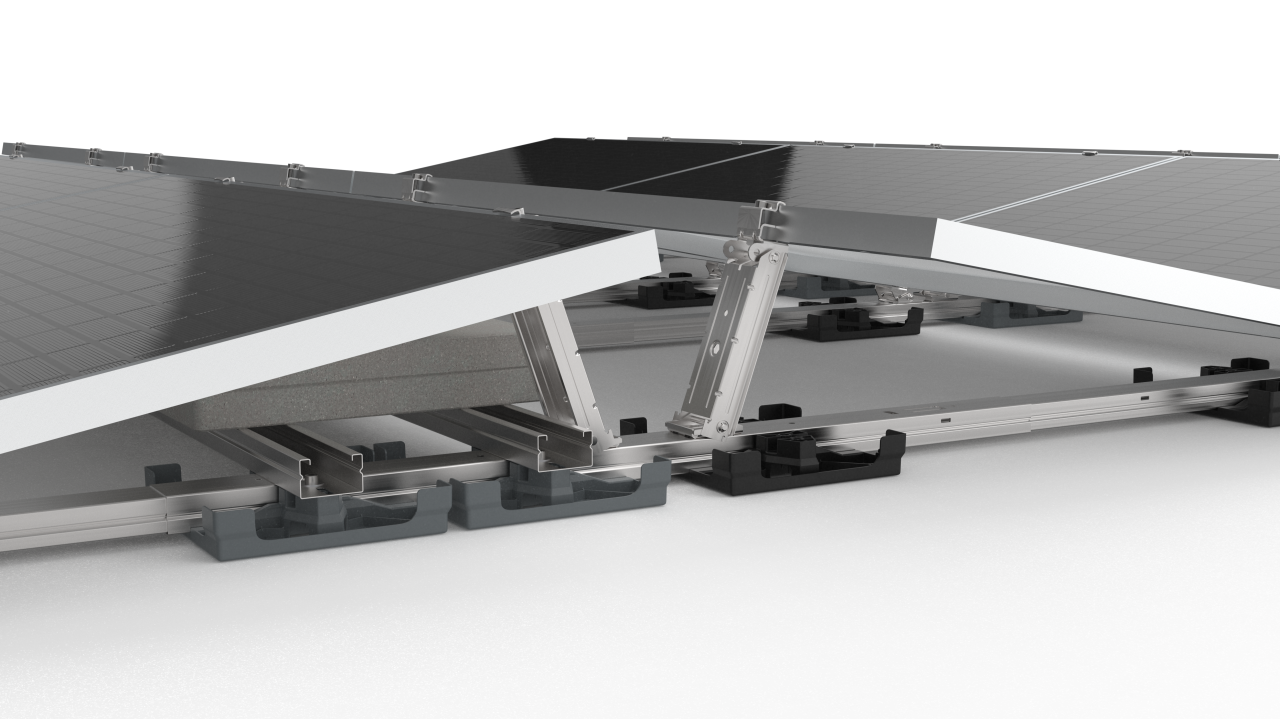
The solution: the PMT team developed a hinge function for PMT X118, allowing the craftsmen a swivel installation. Simple and ingenious. With this, the modules can be pre-assembled/placed, wired, and fixed from the long side by one person, depending on the wind intensity. When everything is done, the modules are swung into position and fixed.
And the Stadtsteinach-based company is thinking one step further: the unique swivel system is also an innovative idea for maintenance. To service the modules, only two of the four screw points need to be loosened. Inspection is quick and safe, with no risk of damaging the photovoltaic system. Repowering the system, for example after weather damage, because modules have reached the end of their service life or for other reasons, is also much easier to implement. A sustainable and efficient solution for installation teams and customers.
‘With PMT X118, we are providing a new way to safely install photovoltaic systems on roofs,’ PMT Managing Director Jörg Weber-Schorsch is convinced. ‘The innovation offers an optimal and low-risk solution for handling modern solar modules. The roof area can be used more efficiently, increasing energy production on flat roofs. This way, building owners can supply their property with sustainable energy and actively help shape the energy transition.’
EasyPlates: the stable base for every roof
Another challenge of solar technology is the load distribution on the roof. If more existing buildings with partly less suitable roofs are to be upgraded to solar power plants, they must be able to withstand the wind and snow loads that occur. In addition, the systems should affect the roof structure as little as possible. This is achieved by distributing the loads over as large an area as possible and avoiding point loads. To achieve this, extensive roof renovation was previously necessary. A cost and effort that owners shy away from.
PMT’s engineers have developed an ingenious solution: the cross-bonding technology of the EasyPlates. These are not just simple mounting pads. They form the key element of this unique solution. The plates are connected crosswise via the EasyPlate Connection, transferring the forces acting on one rail to the neighboring rail, ensuring a more even distribution of loads compared to other market solutions.
The connected rows of modules form a unit with a strong system bond. This large-scale unit increases the stability of the system and makes it less susceptible to even stronger wind loads. Components of this cross-bracing serve as a cable duct, through allowing the cables to be routed securely and protected.
Reduced load and increased adhesion
The strong connection, for which PMT has developed particularly stiff profiles, requires fewer ballast stones to secure the system on the roof. This significantly reduces the overall load. The resulting bond, combined with degrees of freedom for thermal expansion and the specially structured EasyPlates mounting pads, counteracts the caterpillar effect. The mounting system protects itself and the photovoltaic system from slipping.
PMT draws on the learnings from over ten years of project implementations and extensive tests to take this approach even further. The integrated structural protection protects the roof and enables safe access to roofs with more challenging conditions.
Three solutions for all conditions
PMT currently offers its customers three variants of the EasyPlate solution: the EasyPlate Support, the EasyPlate Connection and the EasyPlate Gravel.
EasyPlate Support is used for a maximum contact area for the required ballast stones. It is designed to maximize the load-bearing surface and protect the roof.
EasyPlate Connection creates the stiffening connection between the rail components. The plate’s screw function can be easily connected to the Swift Rail and the Row Connector.
EasyPlate Gravel is the optimum solution for gravel and granulate-covered roofs.
In addition, the cross connections of the EasyPlates can accommodate ballast stones, making PMT X118 the ideal photovoltaic mounting system for existing buildings. A solution that heralds the future of solar system mounting.
A sustainable system solution
Identifying industry challenges and developing sustainable solutions is one of PMT’s core competencies. X118 also features the company’s proprietary Push-&-Click technology, which minimizes sources of error. The components of the systems can be assigned without any doubt. No additional measurements are required for the substructures. The installation team can be sure that the components are stable and correctly installed by an audible click of the parts.
‘Extensive tests with comprehensive scenarios ensure the high quality of our product genetics,’ emphasizes Wagner. Wind tunnel tests, digital simulations and tests on in-house tensile testing machines and friction test benches are part of the PMT standard. Customers can rightly trust and rely on the results.


-1.jpg)