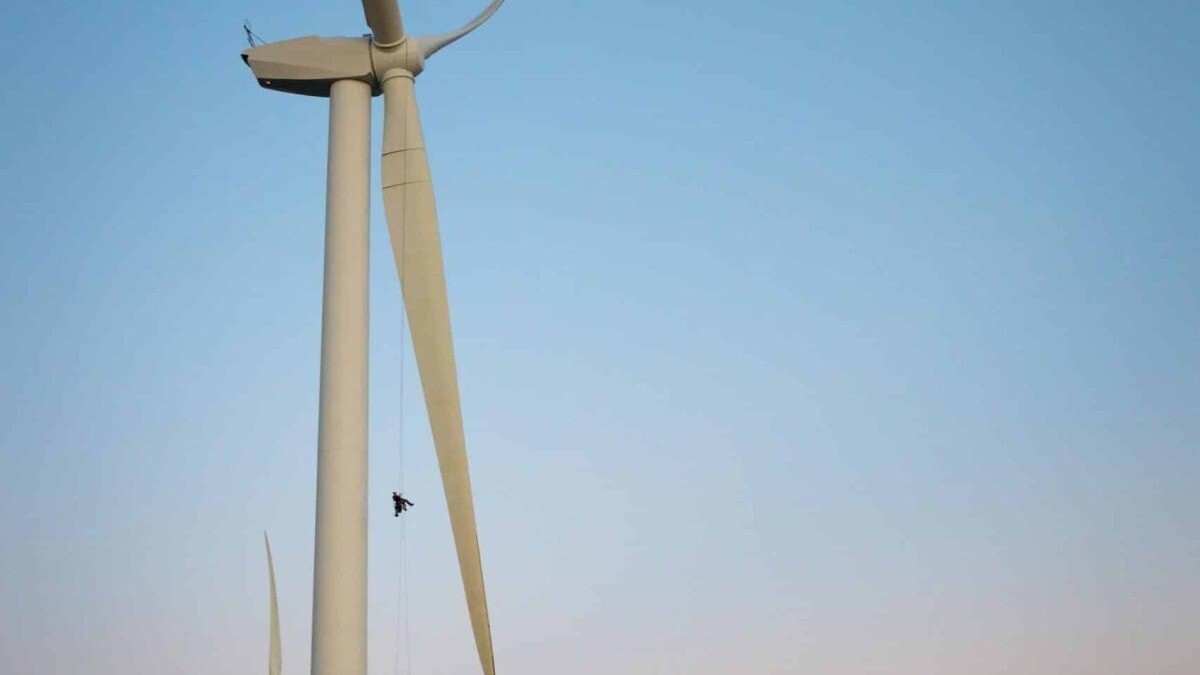
The wind industry has reached a tipping point where early-years blade erosion is becoming an increasingly common phenomenon. This issue is driven by the rapid advancement in turbine technology over the last decade. As blade lengths have increased substantially, tip speeds now exceed 200 mph. This, combined with turbines being placed in harsher operating environments, accelerates the rate of erosion.
Offshore, sites are being developed further from shore, which brings higher wind speeds and greater average rainfall, leading to faster blade damage. Onshore, a similar dynamic exists, with airborne particles like dust and sand compounding the effect of increased rainfall and longer blades. In places like India and the USA, significant blade damage has been observed within just two years of operation due to these factors.
The impact of this erosion is significant. Academic studies suggest that leading-edge erosion can reduce a wind farms overall Annual Energy Production (AEP) by around 3%. Despite advances in turbine technology, the fundamental construction of blades—principally glass fibre and resin—has not changed, and these materials will always erode over time. Significant erosion within five years is now not uncommon.
Shifting from Reactive to Proactive Maintenance
Historically, operators have often taken a wait and see approach to erosion, but this results in turbines operating at sub-optimal performance. Now, operators and Original Equipment Manufacturers (OEMs) are adopting new, proactive strategies to avoid costly downtime. This includes making leading-edge repairs early, before performance degrades significantly.
The issue of responsibility is often a grey area, as leading-edge erosion may or may not be included within a typical five-year warranty period. Regardless of who is responsible, operators face lost revenue for every day of non-production, making the minimization of repair time critical.
An Innovative Solution: Thermoplastic Shields
In response to this challenge, Armour Edge is working with OEMs to explore factory-fitting its patented blade protection system, which could deliver a 50-year erosion-free lifespan. The solution uses a bespoke version of INEOSs ultra-tough Luran® SC thermoplastic material. Each shield is up to one meter long and is custom-formed to the exact blade type before being bonded into place by trained technicians.
The durability of this solution was validated in a series of comparative tests by The Offshore Renewable Energy (ORE) Catapult, the UKs leading research centre for offshore renewables.
- Accelerated Testing: In accelerated rain erosion tests, the Armour Edge shields lasted an average of 232 hours, while other solutions like tapes, coatings, and soft shells lasted between 10 and 160 hours.
- Lifetime Prediction: Using a lifetime prediction methodology based on ORE Catapults offshore rain data, the model predicted the Armour Edge protection would last 53.4 years—far longer than the expected lifespan of a turbine.
- Aerodynamic Performance: The ORE Catapult report noted that the shields degraded much more evenly than other forms of protection, resulting in significantly less loss of aerodynamic performance. A subsequent study by Natural Power Consultants confirmed a negligible impact on turbine performance at rated wind speeds and above.
This type of long-life blade protection could be a game-changer for the industry, potentially altering the economics of wind farms by removing multiple days of downtime and lower yields from the operational lifecycle.
Discover more about this durable blade protection: https://www.armouredge.com