As offshore wind projects grow in scale, the engineering challenges they present are becoming increasingly complex. Larger turbines mean heavier loads, critical lifting points, and safety-critical connections that demand flawless execution. To meet these demands, André van Nijnatten of AnMa-TECH BV and Alfred Versteeg of Dutch Heavy Lift Consultants (DHLC) have joined forces to redefine safety and efficiency in turbine installation through the innovative Flange Alignment System (FAS).
In this exclusive interview with PES Wind, they discuss how their collaboration is driving progress in the offshore sector.
The Growing Challenge of Giant Turbines
The massive increase in turbine size over the past decade has fundamentally changed the landscape for installation contractors. Equipment is heavier, connections are more complex, and the margin for error is non-existent.
- For AnMa-TECH: The focus is on developing precise, efficient methods to handle larger, safety-critical bolted connections under extreme conditions.
- For DHLC: The priority is refining engineering methods to ensure heavy lifting and positioning operations are executed safely, accurately, and cost-effectively.
The Genesis of the Flange Alignment System (FAS)
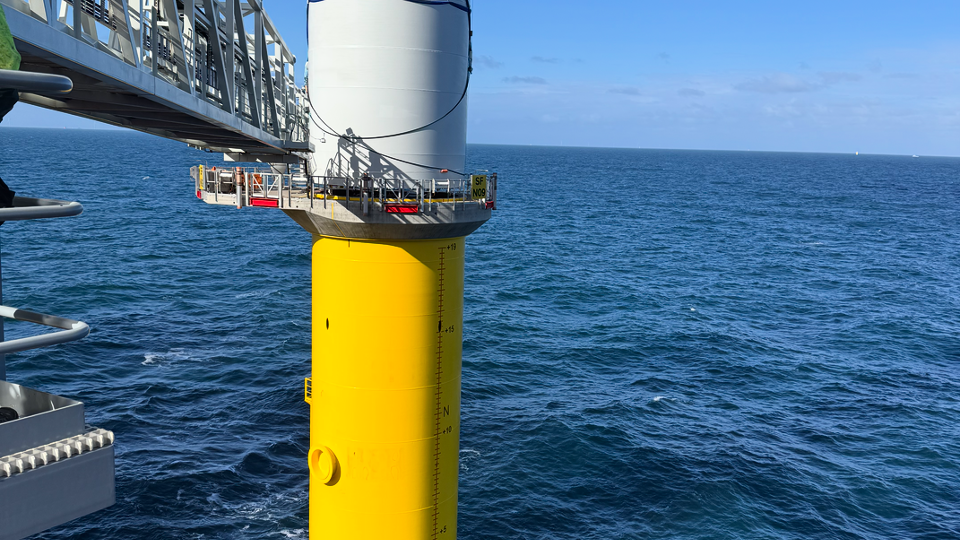
The FAS was born from a direct industry need. A client approached AnMa-TECH seeking a safer, more efficient way to align the transition piece (TP) and monopile (MP) connection, specifically addressing issues of flange deformation and ovality.
Originally designed purely for alignment, the system has evolved into a versatile DNV-certified tool capable of both alignment and correction. This dual capability is a game-changer for project schedules and risk management.
Speed, Safety, and Savings
Offshore projects operate on tight schedules where weather windows and vessel costs create immense pressure. The FAS addresses this by offering a controlled, localized method for correction that drastically reduces downtime.
- Rapid Execution: Alignment can be completed within minutes, while reshaping takes around three hours—a major time saving compared to traditional methods.
- Reduced Risk: By minimizing manual effort and operating in a controlled manner, the system improves reliability and safety during critical operations.
- DNV Certification: Independent approval confirms the system maintains structural integrity without introducing excessive stress, giving clients confidence in its long-term reliability.
Customization Meets Standardization
Every project is unique, but the core technology remains consistent. DHLC and AnMa-TECH work together to tailor the FAS to specific client needs through detailed engineering, combining proven technology with flexible innovation.
"Every project begins with a question," says Alfred Versteeg. "From there, we move into detailed engineering to tailor the solution... delivering results that are both dependable and efficient".
Looking Ahead: Supporting the Energy Transition
As turbines continue to grow, the importance of perfect flange positioning will only increase. The FAS is positioned to meet these future challenges, simplifying complex tasks and delivering tangible cost benefits.
For both André and Alfred, this work is about more than just engineering—it's about driving the energy transition. "It's an industry driven by innovation, and we're proud to contribute to that transformation," says André van Nijnatten.


(1)_wide-1.png)