Inadequate grease lubrication is a common cause of bearing failure and mechanical breakdown, particularly in wind turbines exposed to variable and extreme operating conditions. Yet predicting how grease behaves inside a bearing has traditionally been difficult.
A collaboration between Shell Lubricants, SKF and the University of Twente is addressing this challenge through the University Technology Centre for Grease Lubrication (UTC), developing models intended to predict grease performance and bearing service life more accurately.
Why grease performance matters
Grease provides a lubricating film that separates rollers from bearing rings, helping to prevent metal-on-metal contact. According to Rihard Pasaribu of Shell Lubricants, grease lubrication issues account for a significant proportion of unplanned downtime.
Piet Lugt of SKF explains that grease can offer lower friction, wear and energy losses compared with oil-based lubricants, but its behaviour under extreme and variable conditions is less well understood.
The research therefore focuses on film thickness. By understanding how a lubricating film forms under different operating conditions, the team aims to improve predictions of both grease and bearing performance.
Key variables being investigated include:
- Grease rheology and flow behaviour
- Film thickness
- Operating conditions
- Grease softness and hardness
- Bearing geometry and speed
This is particularly relevant as wind turbines and their bearings become larger and operators need greater confidence in lubricant performance over time.
Combining industry and academic expertise
The collaboration brings together three areas of knowledge. Shell contributes lubricant expertise, SKF provides bearing knowledge and the University of Twente contributes research, modelling and laboratory facilities.
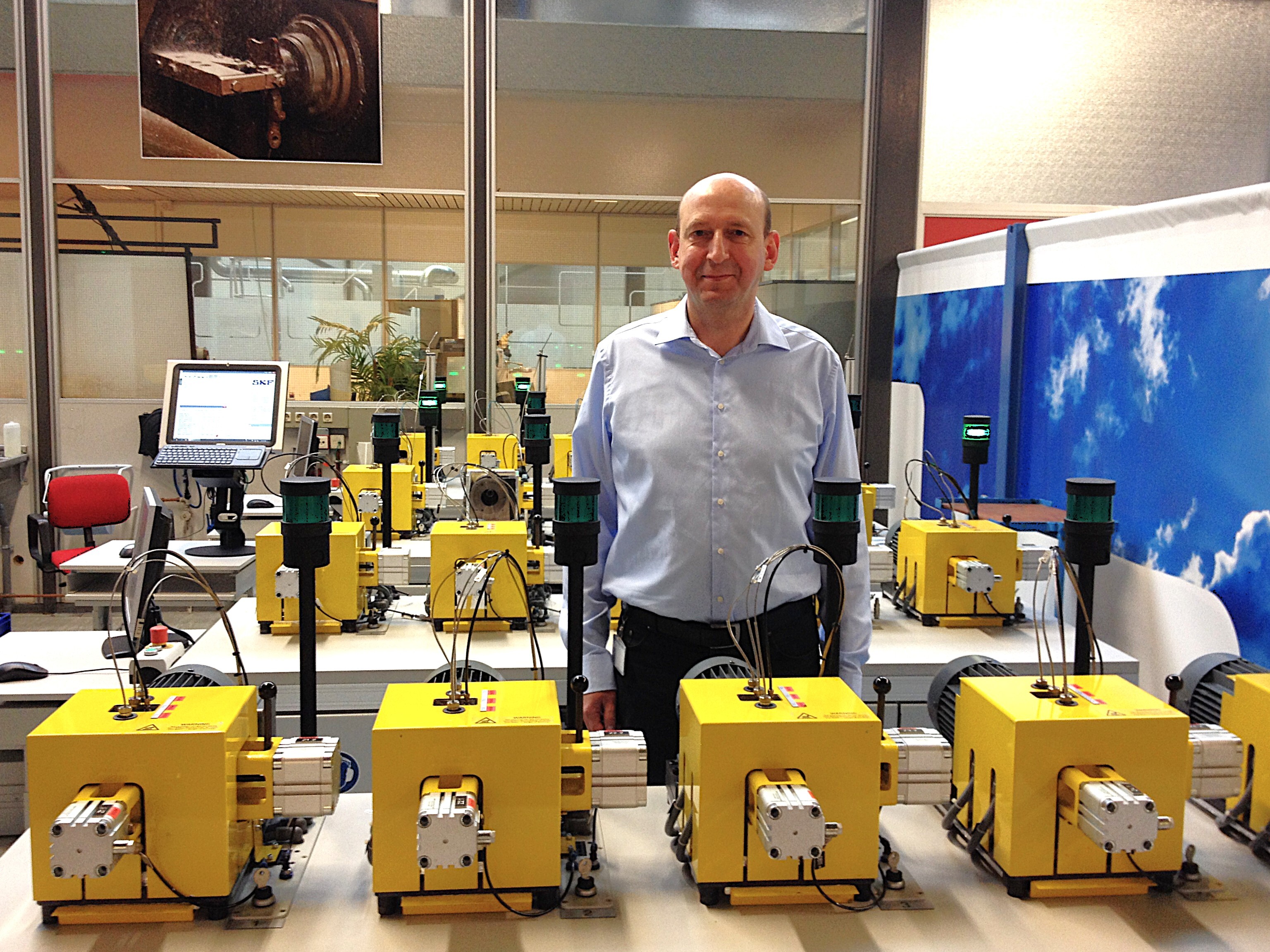
The laboratory includes specialist equipment developed to test grease behaviour under controlled conditions.
For the university, working directly with industry also gives researchers and students access to practical engineering challenges. Jude Osara of the University of Twente says this helps place academic results in the context of real grease applications and end users.
Looking at the complete bearing
One distinctive aspect of the research is its focus on the complete bearing system rather than a single contact between one roller and one ring.
Bearings contain multiple rollers and two rings, creating a more dynamic system. Using base oil viscosity, half contact width and linear speed, the researchers developed an approach to predict relative film thickness in loaded deep groove ball bearings.
The work resulted in the paper ‘Film Thickness in Grease-Lubricated Deep Groove Ball Bearings: A Master Curve’, which received the Society of Tribologists and Lubrication Engineers’ Captain Alfred E. Hunt Memorial Award.
Lugt says the research is already contributing to SKF’s bearing prediction models, which can help operators estimate grease life, relubrication requirements and bearing life.
From research to operating decisions
For Shell, the findings provide a stronger empirical basis for understanding why particular greases behave as they do. Pasaribu says there are no immediate plans to change the overall design of its greases, but greater understanding could inform future formulations and recommendations.
The research team can isolate individual grease properties while keeping other variables unchanged, helping determine which characteristics have a meaningful effect on performance.
The wider objective is predictive maintenance. In many real-world applications, failure must occur before its cause can be fully understood. Physical models offer the possibility of identifying performance limitations earlier and applying laboratory findings to operating equipment.
For wind farm operators, better grease modelling could therefore support lubricant selection, relubrication planning and bearing-life predictions.
The collaboration also demonstrates the value of combining practical industry knowledge with specialist academic research. As Osara notes, understanding grease performance continues to develop, but considerably more is known today than a decade ago.
Read the full interview with Shell Lubricants, SKF and the University of Twente on grease lubrication, bearing performance and predictive modelling in PES Wind: https://pes.eu.com/exclusive-articles/when-industry-meets-academia-unlocking-the-future-of-grease-lubricated-bearings