Energy storage is becoming critical to balancing grids with high levels of renewables, but long-term project success hinges on disciplined integration, smart operation and the right partnerships. According to DNV's Energy Transition Outlook (ETO) report of 2025, grid flexibility tops agendas as renewables surge, predicting that from 2030 onwards, flexibility in the energy system will increasingly be supplied by storage. Luis Serrano, Growth Segment Director for BESS at GreenPowerMonitor, a DNV company (GPM), outlines the key technical and strategic parameters needed to navigate this expanding sector.
Analysing global trends in the energy storage market
Global forecasts show that solar, both with and without storage, alongside wind will make up 32% of the global power mix by 2030, driving a major surge in BESS deployment.
- Prominent global market players: China, the US and the UK have emerged as particularly prominent leaders in the global energy storage sector.
- Rapid advancements in the OECD Pacific: Grid modernisation and BESS are advancing rapidly in specific regions, with Australia leading the OECD Pacific segment with over 10 GWh of capacity in its development pipeline.
- Financial policy drivers in Asia: In Japan, solar curtailment subsidies serve as a primary driver for BESS uptake, while South Korea has established a structured, centralised contract market framework specifically for standalone BESS.
- Ambitious renewable additions in India: By 2030, India is forecast to achieve 525 GW in total renewable capacity installations through a combination of utility solar PV, rooftop solar and wind, which includes nearly 70 GW of integrated solar-plus-storage assets.
Unveiling hidden hurdles to BESS and hybrid project profitability
Despite strong market projections, several overlooked operational and financial obstacles have the potential to stand in the way of achieving the robust returns that developers expect.
- Overlooked early-stage operational warnings: Minor cell temperature shifts or intermittent inverter-to-BESS communication issues are often disregarded, yet they frequently signal deeper underlying technical problems that can eventually escalate into expensive outages.
- Financial risks tied to warranty oversight: Operating battery storage assets beyond defined throughput limits, running equipment outside authorised temperature bands, or failing to properly document events can quickly put vital manufacturer warranty coverage at risk.
- Disconnected asset data sources: Hybrid portfolios often rely on separate, fragmented platforms for operations, finance and compliance, creating organisational ambiguity and increasing the probability of inconsistent reporting across teams.
- Inefficient cycling and dispatch strategies: Financial performance inevitably suffers when a BESS effectively captures the right market intervals but loses cumulative transactional value through low system efficiency or an accelerated decline in the battery's state of health (SoH).
Technical strategies for reliable grid integration and dispatch optimisation
Long-term project viability depends on deep technical discipline, establishing grid-code compliance and executing full physical and functional integration between battery packs, solar arrays and inverters.
- Functional separation of hybrid assets: By routing renewable generation directly to the utility grid and treating the BESS as a parallel asset, operators successfully reduce business interruption risks and avoid making overall project profitability entirely dependent on battery availability.
- Advanced grid-support control capabilities: Features built directly into systems, such as power oscillation damping (POD) control, black-start functionality, grid-forming modes and synthetic inertia, are becoming increasingly central to meeting modern grid network stability expectations.
- Intelligent energy management system (EMS) platforms: Managing over 110 GW of clean energy assets worldwide, GreenPowerMonitor delivers an Enhanced EMS designed to maximise battery performance by optimising energy dispatch, maintaining grid reliability and extending asset lifespan.
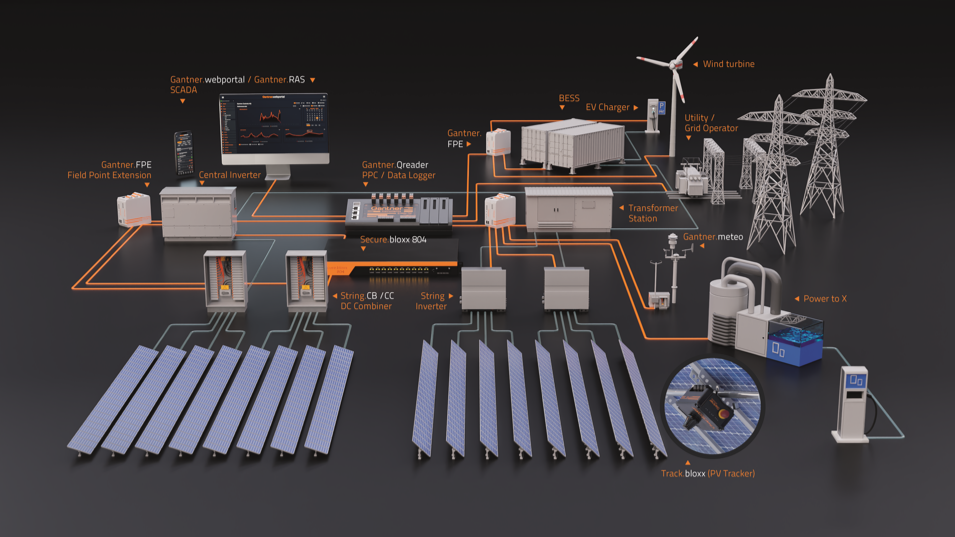
- Seamless coordination via hybrid energy management systems: GPM’s Hybrid EMS (HEMS) manages internal power flows to ensure seamless coordination between solar PV arrays and BESS units, maximising cost-effectiveness and compliance with localized network constraints.
- Centralized portfolio monitoring with Horizon: For multi-technology portfolios spanning solar, wind and storage, the Horizon software platform provides integrated monitoring, near real-time insights, automated KPI tracking and centralised alerts to close the operational knowledge gap.
How is your asset management team using Hybrid Energy Management Systems (HEMS) and advanced grid-forming capabilities to de-risk warranty compliance and optimize battery cycling efficiency? Share your thoughts in the comments below.
Looking for the full technical breakdown? To review strict compliance frameworks, including UL 9540/9540A and NFPA 855 engineering designs and examine dynamic simulation profiles, visit the official GreenPowerMonitor portal at greenpowermonitor.com: https://pes.eu.com/exclusive-articles/powering-flexibility-setting-bess-projects-up-for-success