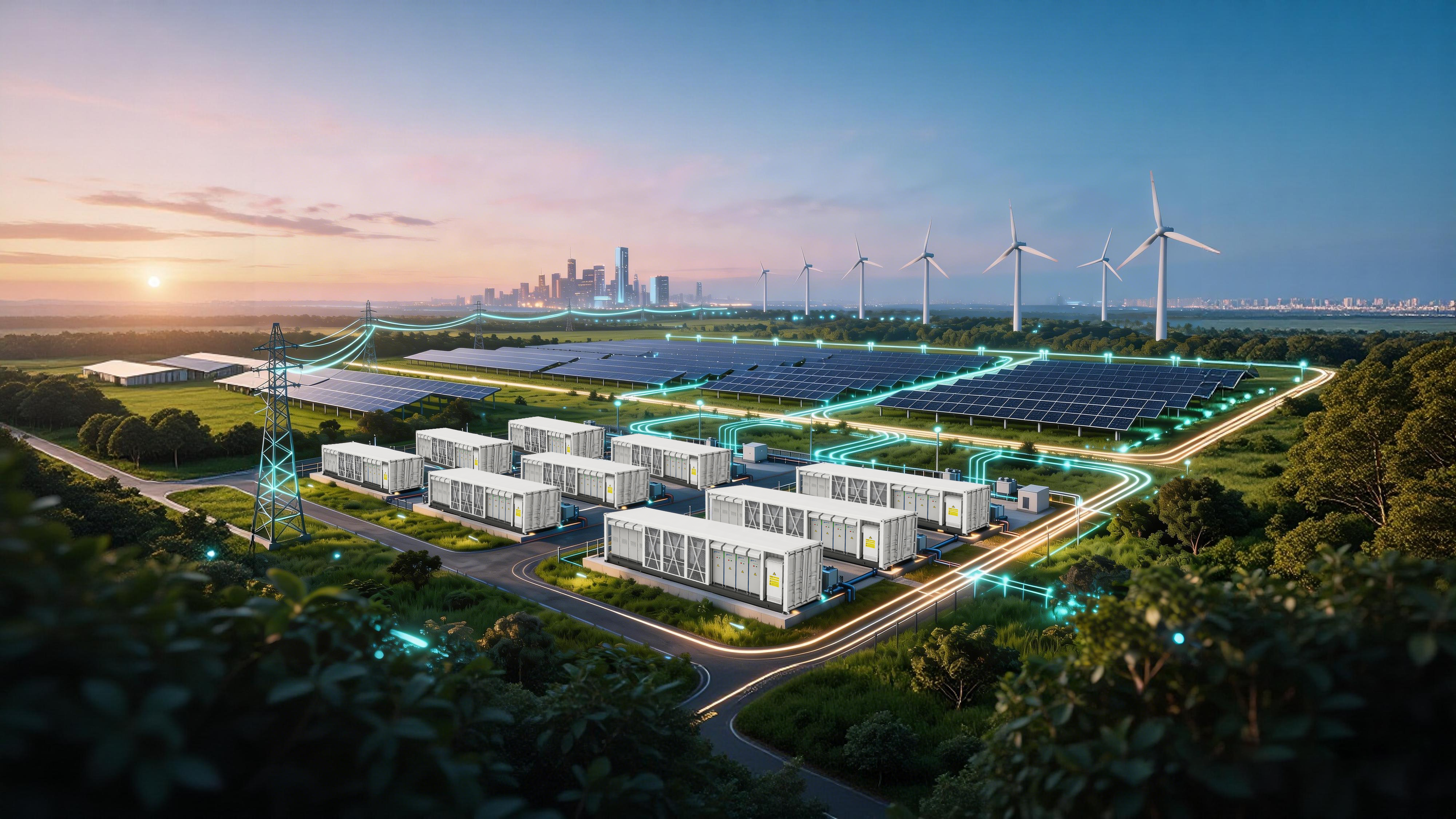
The global shift toward renewable energy is fundamentally reshaping the architecture and operational dynamics of modern power systems. Traditionally, grid stability has been maintained by synchronous generators in thermal and hydroelectric power plants, which supply rotational inertia, voltage regulation and fault current contribution to stabilize system frequency and voltage.
In contrast, inverter-based resources, including solar and most battery systems, do not inherently provide these stabilising characteristics, leading to declining system inertia and weaker networks. To address these challenges, grid-forming energy storage systems have emerged as a critical technology, providing active regulation of voltage and frequency in low-inertia power systems.
Understanding the need for advanced control technologies
Lower system inertia introduces serious technical challenges that threaten the operational integrity of the network, requiring advanced solutions to allow secure grid operations.
- Evolving network vulnerabilities: Reduced system strength results in higher rates of change of frequency (RoCoF), decreased fault current and heightened voltage sensitivity.
- Susceptibility to disturbances: Low-inertia conditions make modern grids much more vulnerable to oscillatory instability and transient disturbances.
- Regulatory push for adaptation: Frameworks are evolving to encourage grid-forming capabilities; for example, the European Network Code on Requirements for Generators (NC RFG 2.0) explicitly pushes for the strategic adoption of inverter-based resources with grid-forming functions.
- Active network regulation: Unlike conventional grid-following units that depend on an external grid reference, grid-forming systems actively establish and regulate voltage and frequency to support high renewable penetration.
Core technical functions of grid-forming units
Modern grid-forming energy storage platforms integrate advanced electromechanical emulations to handle grid disturbances and maintain localized power quality.
- Operation in ultra-weak grids: These systems are specifically designed to operate effectively under ultra-weak conditions where short circuit ratios (SCR) fall below 1.1, a threshold that regularly cripples conventional converters.
- Robust overload and fault ride-through: During short circuits or voltage dips, the units can deliver temporary overloads of up to 3 In for 10 seconds at the system level, backed by comprehensive low-voltage (LVRT) and high-voltage ride-through (HVRT) capabilities.
- Phase jump tolerance: The technology accommodates abrupt grid variations and shifts, maintaining continuous operations for phase angle shifts within ±60 degrees by rapidly injecting or absorbing active power.
- Synthetic inertia and damping: Dynamic reactive power management controls voltage fluctuations, while active power is regulated to emulate inertia based on system RoCoF, allowing damping control to suppress network oscillations.
- Seamless islanding and black starts: Transitions between grid-connected and islanded modes occur at millisecond-level precision, while independent black-start functionality allows units to re-establish voltage and frequency without external support.
System configurations and real-world validation
To accommodate distinct utility and industrial scales, grid-forming solutions are deployed across highly adaptable, commercial hardware configurations.
- Flexible modular options: System formats range from modular string units (250 kW to 430 kW) with rack-level management to dense central units providing 1,250 kW to 1,725 kW of high power density.
- High-capacity containerization: Fully integrated 40 ft containerized systems combine transformers and switchgear to deliver between 10 MW and 13.8 MW per unit.
- Extreme high-altitude deployment: The technology has proven its environmental resilience in technically demanding areas, including a 6 MW/24 MWh installation operating in Tibet at altitudes above 4,500 metres.
- Hybrid chemistry integration: Massive deployment footprints include a 300 MW/1,200 MWh hybrid station in Ordos that combines Lithium Iron Phosphate and Vanadium Flow Batteries, validating multi-unit parallel scaling.
- Rigorous commercial validation: Systematic evaluation of a 100 MW/200 MWh energy storage station in Changsha City under DNV supervision thoroughly verified primary frequency regulation, damping control and continuous fault ride-through across hundreds of scenarios.
How is your utility grid integration team evaluating grid-forming energy storage to manage low-inertia constraints and prevent curtailment? Share your thoughts in the comments below.
Looking for the full technical breakdown? To examine the complete engineering specifications of Sineng's grid-forming solutions and review localized utility validation reports, visit the official Sineng Electric website: https://pes.eu.com/exclusive-articles/grid-forming-energy-storage-strengthening-stability-in-renewable-power-systems