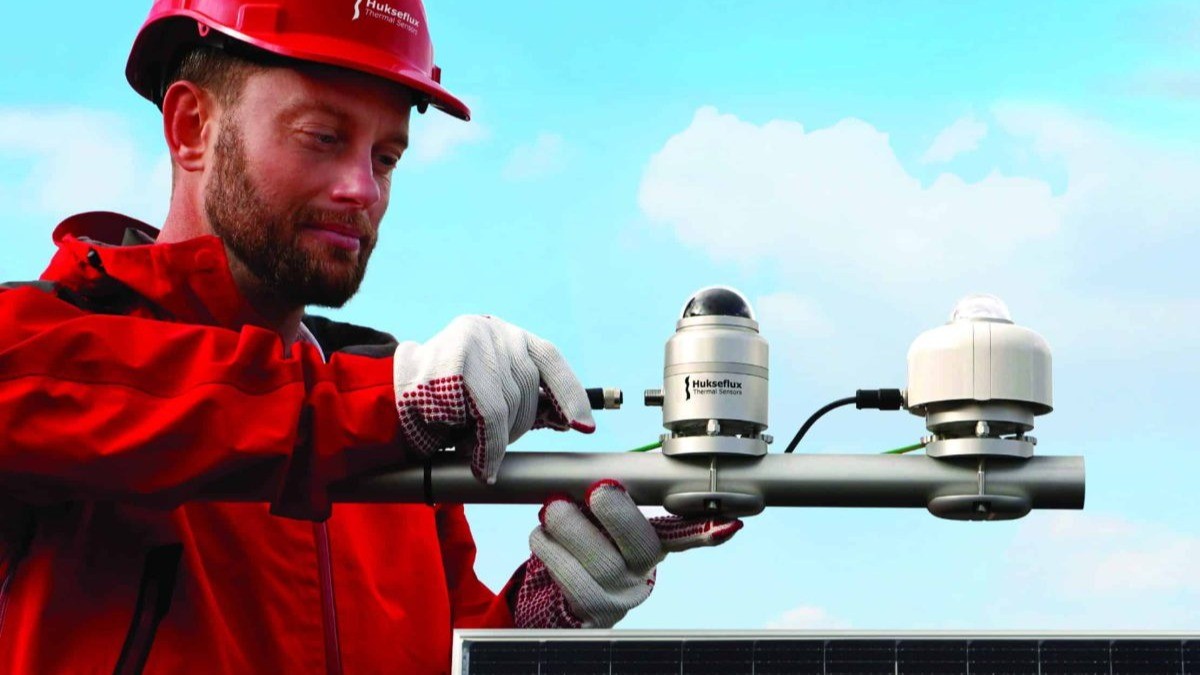
Hukseflux Thermal Sensors has long been recognized as a leader in solar radiation measurement. Building on its reputation for precision and durability, the company has introduced a new sensor—the SRD100 industrial diffusometer—designed specifically to improve the accuracy of photovoltaic (PV) system performance monitoring by measuring diffuse solar radiation.
Why Diffuse Solar Radiation Matters
While global horizontal irradiance and Plane of Array measurements are standard in PV performance monitoring, integrating diffuse irradiance data enhances model accuracy. Diffuse measurements are particularly relevant for:
- Bifacial PV systems (now ~20–30% of utility-scale installations)
- Solar resource assessment during pre-construction phases
- Performance evaluation and asset valuation during operation
Key Motivations for SRD100 Development
According to Jelle Algra, Product Development Engineer at Hukseflux, the SRD100 was designed in response to shortcomings in existing diffuse measurement systems:
- High maintenance requirements
- Frequent inaccuracies
- Dependence on moving parts prone to failure
- Challenging recalibration and servicing in the field
The SRD100 addresses these challenges with a robust, compact, and reliable design that prioritizes:
- No moving parts for enhanced field reliability
- Minimal installation complexity and reduced material requirements
- Ease of calibration and data processing
SRD100 Sensor Design & Functionality
The SRD100 consists of a:
- Robust metal body and glass dome
- Half-sphere shadow mask with a Fibonacci lattice hole pattern
- Sensor array positioned in a horizontal plane beneath the dome
How it works:
- When sunlight hits the dome, the shadow mask ensures at least one sensor remains shaded.
- The shaded sensor captures diffuse irradiance by blocking direct sunlight.
- The unique hole pattern ensures consistent, evenly distributed sky view across all sensors, improving measurement accuracy.
Advantages of the SRD100 for PV Applications
The SRD100 is particularly suited for utility-scale solar installations. Key advantages include:
- High reliability even in harsh environmental conditions
- Reduced need for maintenance thanks to passive design
- Improved measurement redundancy when used alongside pyranometers
- Better performance in cloudy or variable conditions
Protection and Operational Longevity
Electrical surges, particularly from lightning, are a major cause of sensor failure. Hukseflux has addressed this with:
- Industrial-grade surge protection in the SRD100
- Guidance for system designers on grounding, shielding, and SPD integration
- Focus on long-term performance with improved mean time between failures
Design and Engineering Excellence
The development process was a collaborative effort involving:
- Multidisciplinary engineering teams (physics, mechanical, and electronics)
- Complex shading mask design and sensor layout
- Innovative dome manufacturing with precisely sized holes and black coatings
- Efficient, repeatable calibration procedures for reliable performance
Future Developments
With the launch of its new company headquarters in early 2025, Hukseflux is expanding its capabilities for research and development. The company plans to continue advancing:
- Measurement accuracy
- Field reliability
- PV monitoring solutions
More products building on the SRD100’s success are expected, aimed at filling critical gaps in PV system performance monitoring.
About Hukseflux
Founded in 1993 in the Netherlands, Hukseflux is a global leader in precision sensors for solar radiation and heat flux measurement. The company operates globally through offices in:
- The Netherlands (HQ)
- The US
- Brazil
- India
- China
- Southeast Asia
- Japan
Hukseflux continues to innovate and support the renewable energy sector with high-quality instrumentation.
🔗 Learn more: www.hukseflux.com