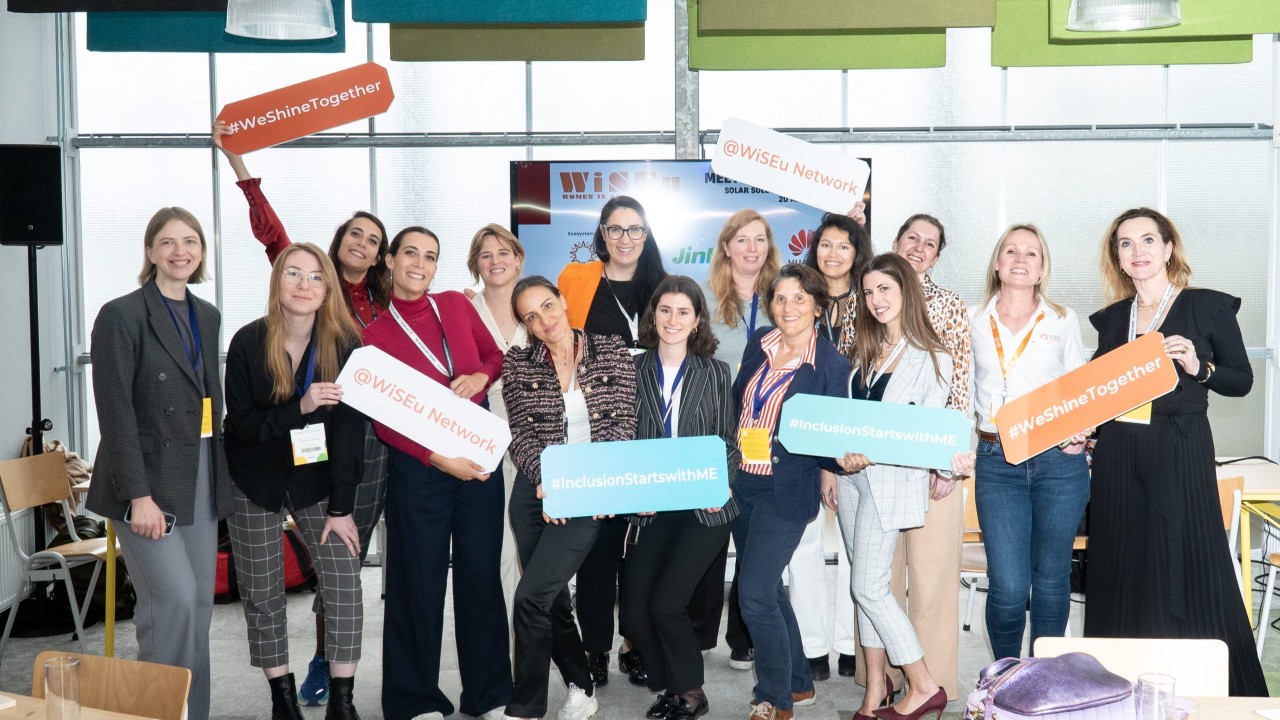
WiSEu Network (Women in Solar Europe) has become a driving force for gender equality since its creation in February 2023. With over 1,000 members across more than 15 countries and supported by leading organisations in the industry, the network focuses on supporting career development for women in the solar and energy storage industry. In this article, ambassadors of the network analyse the business case for supporting equity, diversity, and inclusion and highlight the main barriers women face in their path to leadership.
The workforce constraints in the solar and energy storage sector have highlighted the urgent need to retain, attract and develop female talent. The business case for equity, diversity, and inclusion (EDI) is compelling and multifaceted. Research indicates a positive correlation between gender diversity and organisational profits.
A report by McKinsey & Company found that companies in the top quartile for gender diversity on executive teams were 25% more likely to have above-average profitability than companies in the fourth quartile. This suggests that greater gender diversity at the executive level can contribute to improved financial performance.
The percentage of women in our sector is the highest in the energy industry. Solar (40%) almost double the share of women in the oil and gas sector (22%) or the wind sector (21%), according to the International Renewable Energy Agency’s report ‘Solar PV: A Gender Perspective.’ Nevertheless, according to that report, around 50% of women sit in administrative roles, and only 13% to 17% globally are at the senior management level.
So if the business case is compelling and, as an industry, we do not struggle to attract female talent, why is the number of women leading organisations and departments so low? ‘The answer is as complex as the reality.
We need to look into different aspects that prevent women from reaching leadership positions: social, regulatory, cultural, organisational and the psychological consequences that these have in the capabilities and confidence for women to advance in their careers’, says Carmen Madrid, Founder of the WiSEu Network.
To foster gender equality, it is necessary to analyse and tackle issues at different levels. ‘Every person, regardless of gender, should always be treated with respect in any industry or environment, and we need to start nurturing this balance of equality already from home with our kids so they interiorise that both parents can work, can provide and can be high achievers.
‘We also need to look at the organisation to ensure that somebody always supports women in the company. From the industry point of view, the visibility of women is critical; we need to show up at events, be seen and speak up so the younger generation of women understand that they can grow in this sector and lead in the future,’ says Aga Michalak, Head of Marketing and ESG at JinkoSolar, a leading solar module and energy storage manufacturer and Founding Member of the WiSEu Network.
‘Several forces are needed to strengthen women’s path to leadership. Organisations need to do more in combination with other stakeholders and involved parties, from society to governments, investing and setting up STEM-driven targets from the early years in the educational systems.
‘On the other hand, companies have to create policies for gender equality, to support women, for equal pay, and to encourage career development. So all this has to be done to give opportunities to women to expand their careers and their roles,’ adds Thalia Valkouma, President and CEO at Faria Renewables, a developer and operator headquartered in Greece.
‘In all this expansion of diversity, it is critical to eliminate bias from any hiring or engagement process and that a woman will eventually get pregnant at the peak of the project and leave everybody hanging, and our priorities will change’ says Oana Ijdelea, Managing Partner at Ijdelea & Associates, a law firm specialised in energy based in Romania.
‘Seventy-five per cent of my team leaders are women. And most of them have kids. And I believe they are even more efficient when they have kids because they have to balance many aspects of their lives,’ adds Carolina Nester, Head of Operations, Iberia at Sonnedix, a leading energy producer.
Gender stereotypes from cultural legacies are responsible for many barriers women face in the sector. ‘I’m a Business Development Director at Renergy, an engineering company. It’s common for people to mistakenly assume I’m there to serve coffee or greet guests when they first meet me.
‘In addition, there is what we call the authority gap, or that women in technical fields are not perceived as knowledgeable enough to talk about it or give advice,’ says Mariyana Yaneva, who is also Vice Chairperson of the Board, Policy & Market Design at APSTE, the Association for Production, Storage and Trading of Electricity in Bulgaria.
All these aspects are crucial in how women perceive themselves and their career growth, often suffering from the imposter syndrome, also known as fraud syndrome. In this psychological pattern, individuals attribute their achievements and accomplishments to luck, timing, or other external factors rather than their abilities or qualifications. This term was first coined in 1978 by psychologists Pauline Rose Clance and Suzanne Imes in their paper titled ‘The Impostor Phenomenon in High Achieving Women: Dynamics and Therapeutic Intervention.’
The role of organisations in mitigating these psychological barriers is critical. Awareness of psychological safety is becoming increasingly important. ‘Enabling all employees to learn and make mistakes, and doing it without fear is key to creating collaborative and supportive environments, and this is especially important when it comes to innovative sectors,’ says María Santa María, Head of Projects (BESS & H2), Iberia at Baywa r.e., a well-known developer and service provider.
‘Fear lights up the part of the brain called the amygdala that floods our bodies with concern when we’re in a fight or freeze response. And so, by definition, great creativity, brilliant problem solving, the next innovation, high collaboration, none of these things happen when individuals in organisations become stressed. And that’s the consequence of the absence of psychological safety,’ adds Liz Beck, Founder & CEO at AspiringHR and Leadership Coach.
Fostering equality, diversity and inclusion in the workplace is a conscious effort that many female industry leaders are embracing. ‘It’s a cultural change that needs to happen. Too often, I find myself dealing with competition- and profit-driven work environments. The renewable industry is still very young, and in my opinion, there is no time to fight against each other. We should keep our critical thinking and consider changing the overall system and creating a more human work environment.
‘The philosophy behind our companies has always been ‘People over profit.’ which is a concept that becomes a game changer when applied in real life,’ says Maria Sabella, CEO and Founder of the Italian-based Enlight Energy Services and Co-Founder of Astrea Energia.
But are women the only ones responsible for leading inclusive cultures? ‘We can talk about women leaders, but the more important question is what makes a great leader? I’ve worked for some amazing male leaders and some awful female leaders. I don’t think gender comes into that part of it. I think the important part is parity and balance. I think the need is to bring some balance and attract more women to the industry,’ says Claire Gardner, Marketing Manager, Europe at Solis, a top inverter manufacturer.
According to Solar Power Europe, solar is set to become Europe’s main energy source before the decade’s end. By 2050, solar jobs could grow to 4 million from the approximately 800,000 jobs recorded at the end of last year. ‘There is a policy dimension, an economic/ industrial dimension, and a personal dimension. So, we need to look at the challenges from a holistic perspective. From the policy side, we need to understand if there is enough administrative support for women to enter a certain career path, especially in senior management and executive positions.
‘Then, we also need to examine the industry, do we have more men, or is it traditionally more male-dominated? Women cannot be blamed for not looking for certain job opportunities if they don’t see themselves in that industry or organisation. If an organisation doesn’t show how inclusive and how much they’re willing to empower you, why would you want to apply? And this is, for me, the first thing a woman needs to look for. What are the values of the company you’re looking at,’ says Giorgia Epicoco, Senior EU Affairs Manager and Sustainability Lead at Huawei, a leading inverter and energy storage manufacturer and grid solutions provider.
‘The traditional lack of female representation across leadership positions indicates a continued challenge. In their last report, PWC underscored that many UK energy companies lack female board representation. Women hold only 16% of their share of the board positions. Social factors, such as caregiving responsibilities, slow down career progression.
‘The average age of having kids in the UK is 31 years old, a time when most of us are trying to progress in our careers. But we also need to look at internal factors, too; we need to start asking more questions, taking more risks and being more confident in ourselves, and instead of just focusing on getting more qualifications, we need to work on building relationships and making ourselves more visible in the industry,’ highlights Zoraida Bejarano, Head of Talent Management at NextEnergy Group, a leading investor, developer and service provider.
‘We are in a moment when the solar industry is booming and creating jobs. We are all struggling to find and keep talent in our companies, so this is a big opportunity to rethink how we want our organisations to look and shape the workforce in the way we believe is right,’ concludes Chloé Durieux, CDO and Cofounder at Nexun, a pan-European developer headquartered in France.