Are you confident in the long-term reliability of your offshore wind farms inter-array cables? As the industry pushes towards higher power ratings, operating voltages are increasing to 66 kV and beyond. This shift demands more robust after-installation testing to prevent premature failures and secure grid stability.
The highest risk of failure in these high-voltage cable systems often comes not from the cable itself, but from improper installation of the terminations. Minor imperfections like dust or air bubbles can lead to partial discharges (PD), which can cause outages and significant revenue loss.
HIGHVOLT has developed a next-generation solution that sets a new standard for testing these critical assets, combining a purpose-built Resonant Test System (RTS) with advanced TruePD technology.
The New Standard: Resonant Testing for Offshore Reliability
For high-voltage cables rated at 36 kV and above, resonant testing is the preferred method recommended by industry standards like IEC 63026:2019. Unlike other methods, RTS is highly advantageous for detecting installation-related failures at cable terminations. The system uses a frequency-tuned resonant circuit to energize long cables efficiently, compensating only for the circuits ohmic losses while generating a clean sinusoidal test voltage.
Beyond Conventional Limits with TruePD
A major drawback of conventional PD measurement is its limited range, often less than 1,000 meters, due to signal attenuation in the cable. This makes fully monitoring long inter-array cables a prohibitive effort.
HIGHVOLTs TruePD technology overcomes this limitation.
- It analyzes a lower frequency range and uses advanced signal processing and algorithms like linear predictive coding to find PD signals within background noise.
- This non-conventional method allows for the systematic analysis of PD signals over cable lengths up to 12 km and beyond.
- Practical tests on a nearly 14 km multi-segment cable proved the concept, locating a reference PD signal with an error of less than 0.25% of the total length.
Designed for the Realities of Offshore Operations
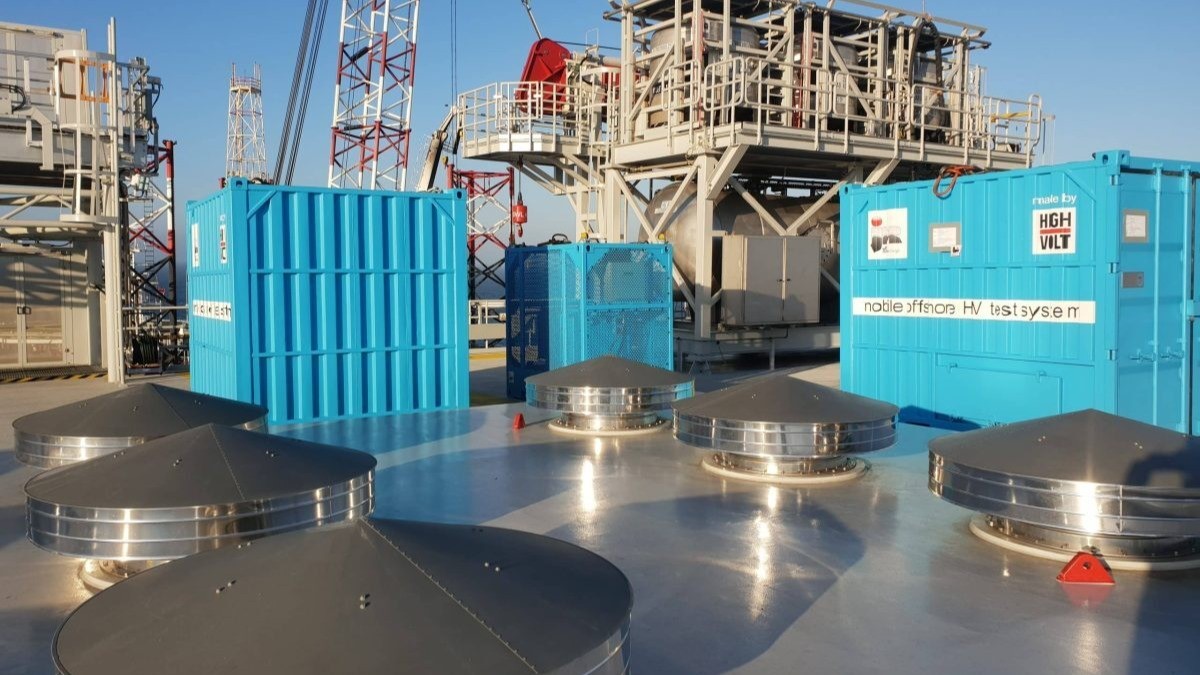
This system was not simply adapted for offshore use; it was designed from the ground up based on the specific requirements of offshore operations and in close consultation with platform operators and test service providers. The design focus shifted from pure technical features to the practicalities of mobilization, transport, and operation in harsh environments.
Key features include:
- Full Offshore Compliance: The system complies with all relevant standards, including DNVGL-ST-E 273 for offshore equipment.
- Modularity and Flexibility: A modular design with a weight limit of 3.7 tons per unit allows for easy transport, a flexible footprint on the substation, and installation by just two technicians.
- Weather-Independent Operation: Offshore-proven coatings and cable connections allow the system to operate safely during heavy rain, storms, and ice.
- Touch-Proof Design: The high-voltage source is electrically isolated, enhancing safety and allowing other work to proceed in parallel, even in minimal space.
This successful development was driven by long-term collaboration between all stakeholders, ensuring the final product meets the true demands of the field.
Discover more about this next-generation offshore testing technology: www.highvolt.com