A recent study found that ‘solar assets are underperforming by an average of 8%’. Part of the problem is that the average photovoltaic project is designed based on standard values for climate-related losses that bear no relation to reality. PVRADAR empowers project developers to achieve world class performance and reliability, across all climatic zones, starting from day one of the development, transparently and traceable.
The success of solar power is under threat
As of 2022, the photovoltaic (PV) industry had reached a monumental milestone, with worldwide installed capacity surpassing 1 terawatt-peak (TWp). This exponential growth trajectory aligns with the goals outlined by the International Energy Agency (IEA), which indicates that sustaining an average annual growth rate of 25% is imperative to effectively combat climate change and achieve the net zero emissions scenario.
Understanding and mitigating these risks is essential for safeguarding investments and maximising the potential of solar energy generation. However, this endeavor is not without its challenges, particularly concerning the impact of climatic conditions on solar power plant performance.
Solar PV energy output is intricately linked to environmental variables such as irradiance and temperature but also detrimental factors like snow and soiling. Yet, these factors are not always adequately accounted for during the early stages of project development, often resulting in overestimated output projections and subsequent underperformance during operation. This discrepancy significantly threatens project profitability and underscores the importance of addressing climatic risks head-on.
Assuming 2% soiling loss flat yearly is not enough
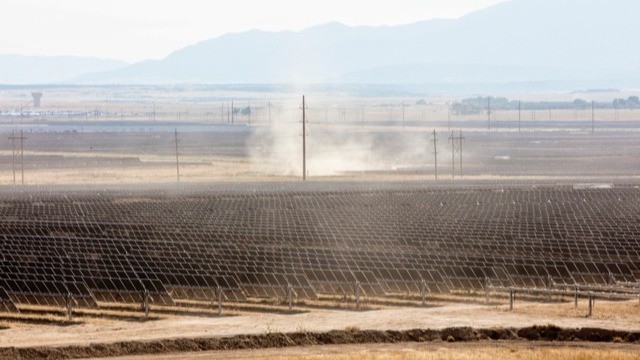
One of the climatic risks with higher impact is soiling, the accumulation of dust and other airborne particles on the surface of PV modules. Soiling diminishes energy conversion efficiency by absorbing, scattering, and reflecting incident sunlight, thereby reducing the amount of light reaching the solar cells.
Despite its pervasive impact, soiling is frequently overlooked during project assessment, resulting in substantial revenue losses. In 2019 alone, global revenue losses attributed to soiling were estimated to range from 3 to 5 billion EUR, highlighting the financial implications of this phenomenon.
Addressing soiling effectively necessitates the implementation of a cost-effective cleaning strategy tailored to specific project requirements. Such a strategy encompasses various facets, including the deployment of cleaning systems such as tractors or semi and fully autonomous robots, the establishment of an appropriate business model, whether service or ownership-based, and determining a cleaning frequency that effectively manages soiling levels.
Cleaning needs to be understood as an investment and the optimal cleaning strategy is the one that constitutes the best tradeoff between cleaning costs and cleaning benefits of reduced soiling losses.
Unfortunately, in general the existing cleaning strategies are far from ideal. Plant operators clean on fix dates, especially in summer without taking into account the relevance of clipping losses. A suboptimal cleaning strategy can even be detrimental for the economic evaluation of the project, by costing more than the benefits it produces.
Another challenge can arise when the soiling problem is addressed after the project is built and operating. At this moment the existing design limits the integration of some of the cleaning alternatives, making it possible that the best solutions are not feasible anymore. Because of this, it is recommended to ask the right questions related to soiling and cleaning as early as possible, to maximise impact.
The key to success is data and modelling
Early evaluation of soiling is essential and can be facilitated through the utilisation of available data, including satellite imagery and soiling models. These tools provide invaluable insights into the historical behaviour of particulate matter and meteorological conditions at the project site, enabling accurate estimation of soiling losses.
Additionally, on-site soiling measurements can refine results by capturing localised phenomena not included in the satellite data alone. However, it’s crucial to note that soiling measurement itself may not fully capture year-to-year variability in soiling conditions, necessitating a comprehensive approach to risk assessment.
Modelling has proven to be a valid alternative to accurately estimate soiling losses. Many authors have proposed different models based on in-site experiences under different climatic conditions but have not yet succeeded in defining a global model that encompasses all climate variables and pollutant types. PVRADAR has the largest database of soiling models and site tests results that allows the use of the models and parameters that best fit each specific condition.
In essence, soiling models aim to quantify the impact of meteorological conditions on the accumulation of mass on PV modules. While wind and particle concentration facilitate mass deposition, rainfall acts as a natural cleaning agent for modules. However, determining the minimum rainfall required for effective cleaning remains a subject of debate, with significant variability depending on pollutant type. Some models even propose multiple thresholds to better capture this intricate mechanism.
Introducing the concept of hard soiling is crucial. This term refers to dirt fractions resistant to rain, necessitating mechanical cleaning for removal. Numerous studies have documented residual dirt persisting post-heavy rainfall, often composed of fine organic particles. The formation of hard soiling depends not only on particle type but also on meteorological conditions favouring accumulation mechanisms like dew formation, cementation, and particle caking.
Theoretical correlations between ‘hard’ dust accumulation and environmental factors have been validated through statistical evaluations of outdoor experiments, affirming the challenges posed by this phenomenon.
However, the current understanding of hard soiling is primarily based on short-term, small-scale research experiences. More evidence, particularly from commercial plant operations, is needed to comprehensively grasp and integrate this phenomenon into operation and maintenance strategies.
The lack of long-term data is attributed to the difficulties in measuring hard soiling, particularly in plants where periodic cleaning removes it, or where mechanical cleaning isn’t applied due to low dust conditions or heavy rainfall, leading to underestimation of its significance.
A field test carried out at a photovoltaic power plant in northern Germany confirms the relevance of hard soiling mitigation. The experiment involved assessing the impact of a first cleaning after four years of operation, with half of the plant cleaned compared against the still dirty half It should be noted that throughout the life of the plant, the decision was not to carry out cleaning due to the favourable rainfall conditions in the area. After some time, and due to the low yield evidenced, it was decided to carry out this experiment.
The results revealed a 2% increase in production from the cleaned portion, with production levels nearly equivalent between both halves before cleaning. This data refutes any potential pre-existing conditions influencing the performance increase, while significant rainfall events prior to the cleanup event discount the possibility of normal soiling impacting the results.
Addressing snow accumulation risks
In northern countries, the increase in solar PV capacity has varied depending on factors such as policy support, technological advancements, and local conditions. However, on average, many northern countries have seen significant growth rates comparable to or even exceeding the global average of around 25% in the last few years.
Solar PV installations in cold climate regions face unique challenges, particularly regarding snow accumulation. In regions such as the Nordic countries, where snow seasons can extend for up to seven months, snow usually accumulates on top of the modules, creating a barrier that blocks sunlight from reaching the solar cells, resulting in reduced energy output.
This effect not only reduces expected energy but also compromises the profitability of solar power plants, jeopardising the continued growth of this industry in cold climates. Additionally, snow buildup can add weight and stress to PV structures, potentially compromising their integrity and safety.
Addressing the challenges related to snow accumulation is crucial for ensuring the reliability and performance of solar PV installations, especially in areas prone to winter weather conditions.
Benefits and risks of albedo conditions
In recent years, the photovoltaic (PV) industry has witnessed a significant surge in the adoption of bifacial cell and module technologies. According to the International Technology Roadmap for Photovoltaic (ITRPV) 2019 Results, bifacial cells accounted for approximately 20% of the global PV cell market in 2020, with projections indicating a substantial increase to 70% by 2030.
Similarly, bifacial PV modules represented about 12% of the market share in 2020, expected to rise to around 30% by 2030. This exponential growth underscores the importance of understanding and addressing the various factors that influence the performance of utility-scale PV power plants.
This scenario highlights a climatic factor that has not always been considered. Albedo is the measure of surface reflectivity and plays a crucial role in photovoltaic generation by influencing the amount of sunlight absorbed by PV modules. Surfaces with higher albedo, such as snowy landscapes or light-coloured materials, reflect more sunlight toward the back of the module, thereby increasing the bifacial gain and final power output. This can be a game changer in the economic evaluation of the project, as the plant output increases significantly without changing the required surface area.
A correct assessment of the albedo conditions is essential to estimate the respective profit and optimise the performance of PV systems. Based on an accurate understanding of this mechanism, design parameters such as AC capacity and consequently, the DCAC ratio can be modified to enable higher energy conversion.
In the same direction, geometrical parameters such as height, tilt and inclination can be managed to make better use of the reflected irradiance. Furthermore, fluctuations in surface albedo, the measure of surface reflectivity, can impact solar PV performance. Changes in albedo due to snow cover, soil moisture, or vegetation can alter the amount of sunlight absorbed by PV modules, thereby influencing energy generation. Understanding and accounting for these fluctuations are crucial for accurately predicting solar energy output and optimising system performance.
PVRADAR: risk assessment and cost optimisation
In conclusion, the performance of solar power plants is inherently susceptible to climatic conditions, including soiling, snow accumulation, and fluctuations in albedo. Addressing these risks through comprehensive planning, innovative technologies, and proactive maintenance strategies is essential for maximising the efficiency and profitability of solar PV installations in diverse environmental contexts.
Using PVRADAR, users can drill down into the techno-economic implications of various risks and their interaction on specific project locations and designs. This tool provides a transparent and efficient assessment of multiple risks, facilitating informed decisionmaking processes.
It also goes beyond risk identification by providing practical information and comparisons of technology options tailored to the needs of each project. Stakeholders can navigate the complexities of climate risks with greater clarity and confidence, ultimately improving the success and resilience of solar projects.