Shingle matrix is synonymous with superior connection technology for solar cells. It is aimed at achieving high module efficiencies, enhanced product aesthetics, and outstanding shading resilience. These are all important properties, especially in integrated photovoltaics (xIPV). The uniqueness of shingle matrix technology clearly stands out in a market with a very homogeneous product range. The technology has unique selling points. However, with a view to remaining competitive in terms of manufacturing costs, highly automated and powerful throughput system technology is required for the economical production of such solar modules. M10 Solar Equipment GmbH provides the plant technology for solar module production, while consistently focusing on new concepts to achieve the necessary machine throughputs.
In conventional solar modules, large efficiency gaps between the solar cell and the final module product are an issue. As the physical efficiency limit for crystalline single junction solar cells has almost been reached, this gap should be viewed as a potential for improving module efficiency and ultimately for increasing energy yields. Shingle technology takes its name from the overlapping arrangement of solar cells, as is the case with roof shingles. Instead of using metal connectors, the solar cells are directly interconnected, electrically and mechanically. A comparative sketch is shown in Fig. 1.
Lead-free Electrically Conductive Adhesives (ECAs) are a widespread choice for interconnecting cells. Shingle matrix technology is therefore already well prepared for a potential end in the future to the solar industry’s exemption from RoHS
Dispensing with the connectors eliminates a source of ohmic losses in the solar module. At the same time, the overlap increases the packing density of the solar cells and reduces inactive areas such as the spaces between the cells. As connectors and the metallization required for interconnection on the solar cells shade part of the silicon, doing without them also results in optical gains. The joint required for shingling is covered by the active cell surface of the neighboring solar cell.
Several scientific studies conducted by Fraunhofer ISE have analyzed the so-called cell-to-module (CTM) loss mechanisms. This methodology groups up to 17 different mechanisms into geometrical, electrical, and optical losses and gains. In harnessing this strategy, the resulting CTM analysis can identify the critical parameters in a module or its components that drive power losses when integrating solar cells into a solar panel. In these studies, the aforementioned advantages lead to an absolute difference in efficiency of between 1 % and 1.5 %.
Assuming a panel efficiency of 25 %, a performance not yet seen in the market, that would convert into a 4 % to 6 % relative efficiency gain. In a best approximation, this would directly translate to a 4 % to 6 % gain in energy yield.
Appearance of shingle solar modules
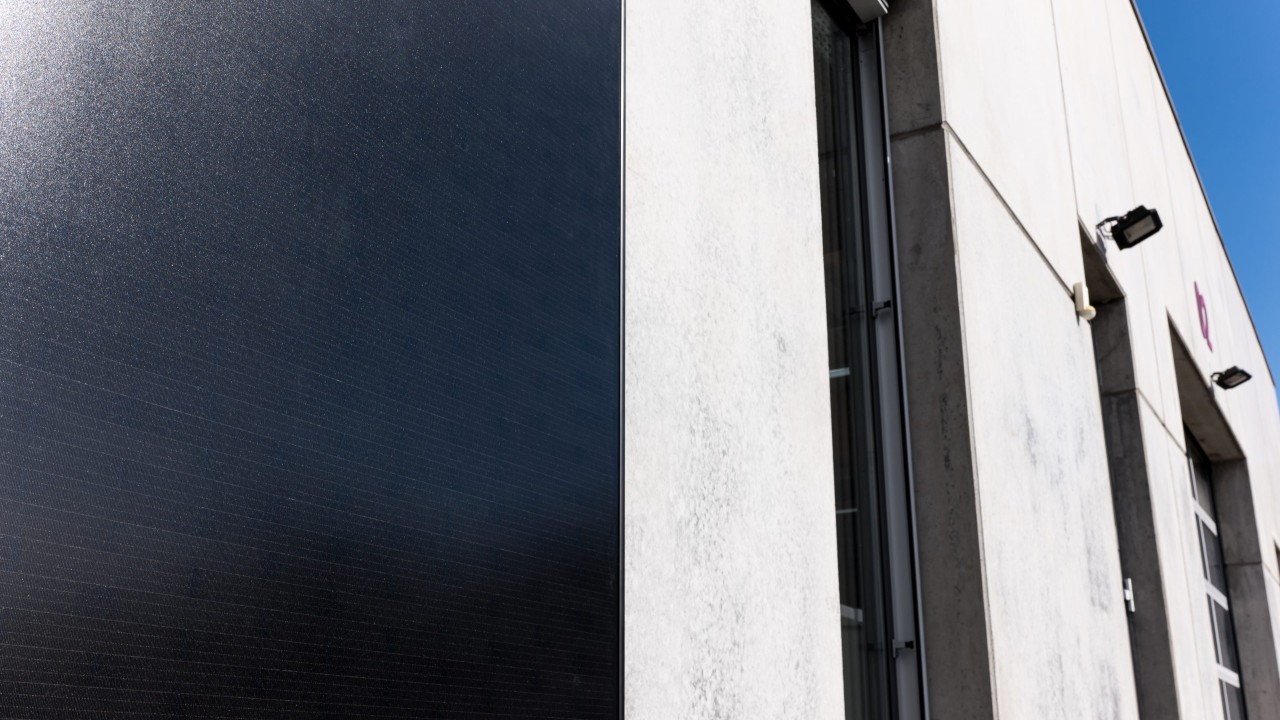
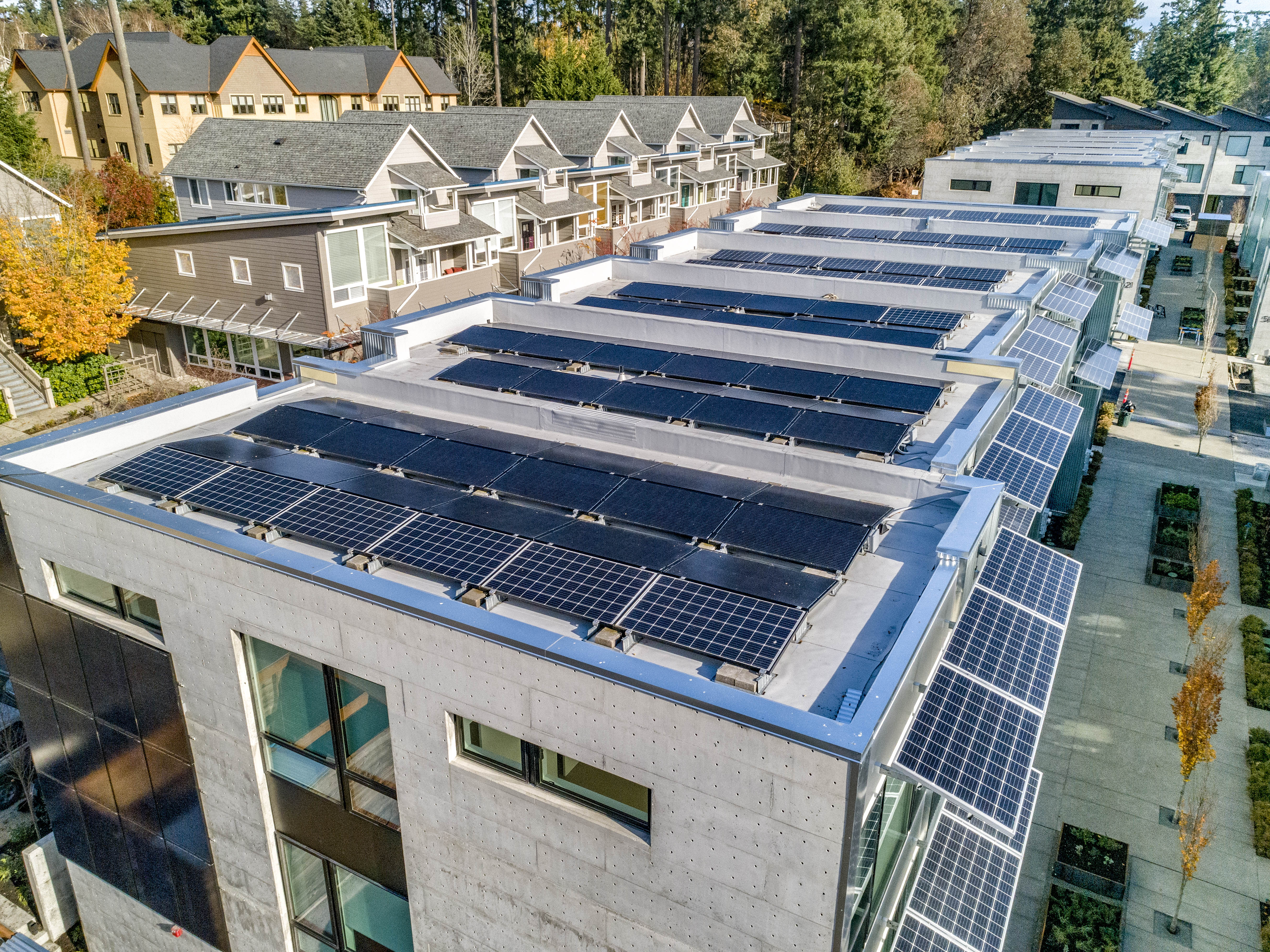
Shingle technology also confers advantages from an aesthetic point of view, as can be seen in Fig. 2. Eliminating shiny, and therefore easily recognizable structures, such as metal connectors and the spaces between cells, makes the appearance of a shingle-matrix module completely homogeneous.
In offering these properties, shingle matrix technology enables the creation of, for instance, electrically active building skins that are not identified as such when standing more than a few meters away. In alternative solutions designed to hide the solar cells, examples being colored meshes or colored glass, reduced transmission through these layers leads to significant efficiency losses. By contrast, shingle matrix technology raises the power output per square meter.
The combination of this virtually chameleon-like capacity, enabling solar panels to visually merge with the building, makes the technology perfectly suited to prestigious and sophisticated architectural installations, with highest expectations placed on appearance.
Shading resilience
In addition to efficiency and appearance, the property of shading resilience plays a key role in the question of the yield that can be achieved with a solar module in xIPV applications. Shading resilience is defined as the long-term average power value of a solar module in the event of shading. Monte Carlo simulations are one way of quantifying this property.
Partial shading and the resulting output of a solar module is a statistical problem. Any number of possibilities exist for casting shadows on a solar module. However, not all of these scenarios need to be considered to arrive at a general statement. The Monte Carlo method facilitates determining a comparable average power value for different modules using randomized random samples, thereby making shade resilience quantifiable.
As the number of samples increases, the mean performance value of all scenarios becomes increasingly robust and, in particular, the statistical fluctuation diminishes. Accordingly, a few thousand calculations allow conclusions to be drawn about average power values for rectangular shadow casts, for example. Especially in this case, shingle matrix technology clearly has the advantage.
Shading resilience is a second and even more important property when moving from power output to yield. Partial shading is one of the most critical loss mechanisms for energy yield. In comparison with the efficiency gain discussed above, mitigating the effects of partial shading is much more effective in improving the energy yield of the installation. In field experiments with constant artificial shading, a standard sized shingle matrix module scored a threefold yield compared to a standard panel of the same power class.
To put this into context: constant shading is not present in common installations, so a threefold yield in common installations will not be the result of using a shingle matrix module. However, this experiment clearly demonstrates that, when partial shading is present in an installation, from an antenna, a chimney, etc., shingle matrix technology will deliver a positive yield balance.
Relevance for industry
In parallel with research conducted at the Fraunhofer Institute for Solar Energy Systems ISE, M10 Solar Equipment GmbH is working on scaling up and industrializing this technology. The first outcome consisted of the ‘SURFACE’ machine platform that won the Intersolar Award in 2022. With a throughput of 12,000 solar cells per hour, SURFACE can produce shingle matrix modules at a competitive price, thus enabling the technology to move from the laboratory to the market.
The higher costs of investing in SURFACE Equipment quickly amortize when viewed from an operational cost standpoint. Lower energy consumption, very low personnel requirements of only 0.5 per machine, and lower overall material costs for the shingle matrix technology compared with the established technologies ultimately lead to similar prices per watt peak produced from the line.
Aside from SURFACE, M10 Solar Equipment offers a second consecutive machine important at the manufacturing level: the SURF-X. After interconnection of the solar cells bussing, then cross connection and implementation of bypass diodes need to be taken care of.
This stage often involves manual work. With the SURF-X, M10 offers a fully automized solution for these processes, which further increases the throughput of a panel manufacturing line. Both machines have been designed for integration with minimal effort into already existing lines. A switch to the shingle matrix technology therefore can be managed by minor changes to an existing line rather than having to implement an entirely new one.
Although both machines are market ready, M10 is involved in several funded research activities with renowned partners from science and industry. The expertise of this group is also focused on continuously improving M10’s SURFACE and SURF-X equipment.