Installing larger monopiles brings new challenges for piling equipment and methods.
Driveability, soil conditions, energy transfer, underwater noise and live monitoring can all affect whether a foundation is installed safely and efficiently. Fabian Hippe, Strategic & Commercial Director at Menck, looks at why increasing hammer capacity is only one part of the answer as offshore wind foundations continue to grow.
Installation starts with foundation design
Before a monopile reaches the seabed, the foundation, hammer, vessel and driving strategy have already been selected. Soil conditions, however, can differ from predictions.
As foundations become larger, relatively small differences between predicted and actual soil behaviour can contribute to:
- Pile run or premature refusal
- Excessive fatigue
- Reduced penetration rates
- Vessel downtime
- Higher installation risk
Preinstallation driveability analyses and Soil Resistance to Driving (SRD) models remain essential, but Hippe stresses that they are predictions rather than guarantees.
Projects therefore need to consider installation limits, decision points and contingency methods early in development.
More energy is not the whole answer
Larger monopiles require greater hammer capability, but maximum rated energy alone does not determine installation performance.
Each impact creates an interaction between the hammer, pile and soil. Some energy produces permanent penetration, while some is absorbed through soil damping, pile deformation and rebound.
Ram mass, impact velocity, the anvil and the interface between hammer and pile all influence how energy reaches the foundation.
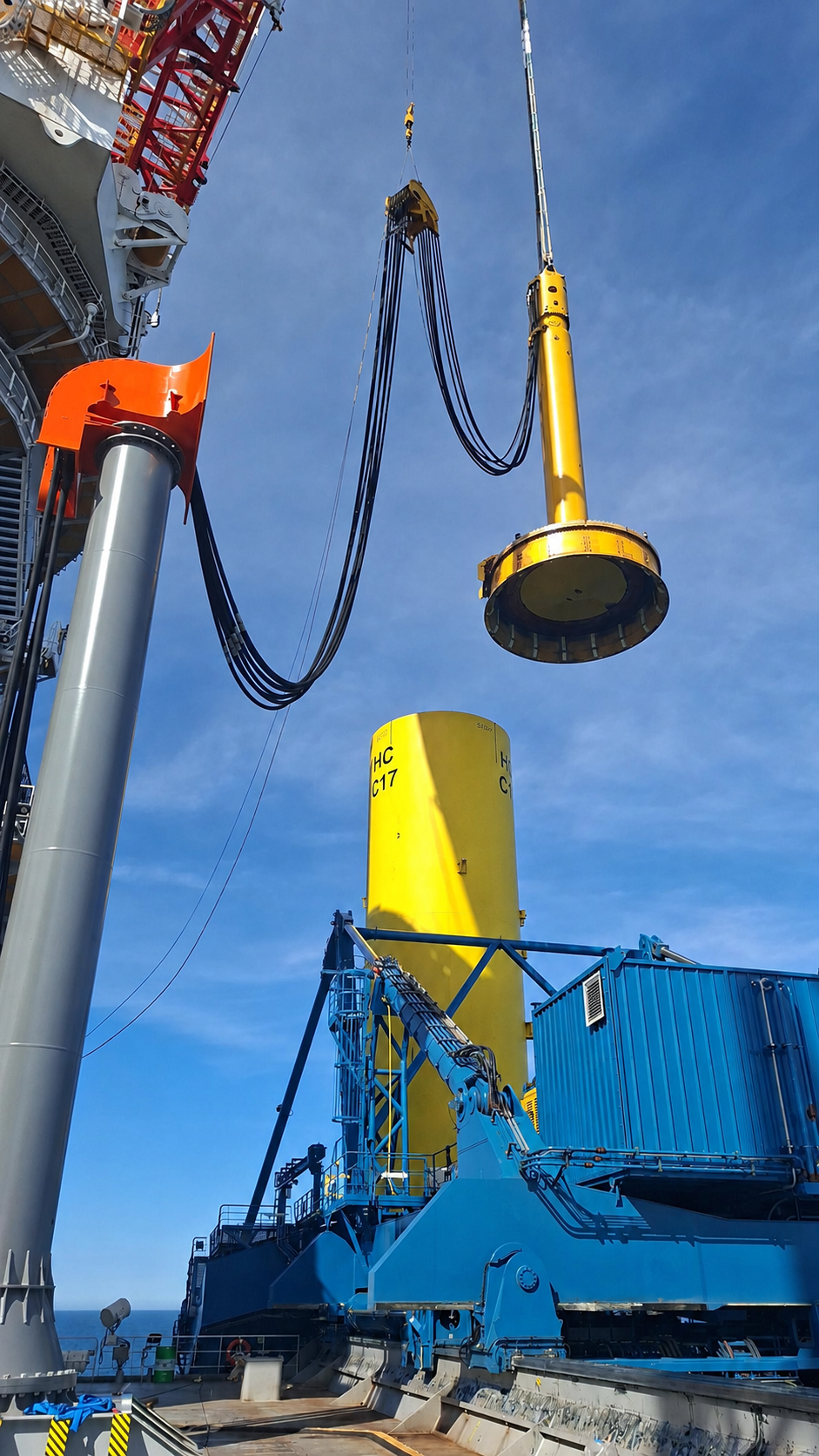
Menck’s MHU 6000W Windhammer is designed to deliver up to 6,250 kJ and accommodate monopiles with top diameters of up to 9 m. The company says its heavier ram and purpose-designed impact chain produce a longer, smoother force-time profile while transferring the required energy efficiently.
Acoustic performance becomes part of installation
Impact piling also generates underwater noise as the steel pile rapidly deforms.
Hippe explains that noise mitigation should therefore be considered alongside hammer design and installation methodology rather than treated solely as an external measure added later.
The MHU 6000W can be configured with source-based noise mitigation, allowing penetration and acoustic requirements to be considered together.
Turning monitoring into operational control
Digital monitoring provides another important development. High-frequency systems can track:
- Hammer behaviour
- Penetration per blow
- Energy transfer
- Pile response
- Force-time signatures
Comparing this information with the predicted installation profile allows teams to identify deviations while driving is still under way.
Hammer energy and blow rate can then be adjusted within approved limits, helping manage penetration, fatigue and noise. Developing pile-run conditions or unexpected resistance may also be identified earlier.
Hippe describes this as moving monitoring from a post-installation record towards an operational control tool.
Learning from every installation
The information collected during one pile installation can also improve later foundations.
Hippe cites one offshore campaign where eight jacket piles experienced pile run. Lessons from that work were applied to a later wind farm in the same area involving more than 300 piles. With digital insight supporting a different operational approach, no pile-run events were recorded.
The important point is that larger foundations require the whole installation system to be considered together. Hammer design, foundation geometry, geotechnical interpretation, acoustic performance, vessel integration, fatigue management and operational data cannot be optimised independently without potentially transferring risk elsewhere.
Bigger foundations need more capable equipment, but successful installation depends just as much on evidence, flexibility and control.
Explore the complete industrial insight in PES Wind: https://pes.eu.com/exclusive-articles/does-size-really-matter-rethinking-monopile-installation









-1.jpg)