The vision of a sustainable future, characterized by solar panels lining the roof of every home, roads bustling with battery-powered vehicles, and reduced reliance on fossil fuels, hinges on the pivotal roles played by electric vehicles (EVs) and renewable energy storage systems. This dream is refined with extended ranges for EVs, rapid charging capabilities, and reliable, safe, and cost-effective battery storage solutions for solar and wind energy. Where the problem lies in attaining this potential is a battery production industry that is currently falling short of these aspirations.
The anticipated growth in demand for lithium batteries by the end of this decade is projected to be over five times the current supply, with the United States expected to secure only 30% of the value in cell production.
While the industry works to expand and respond, conventional manufacturing faces unprecedented challenges, as it works to successfully produce lithium-ion batteries for electric vehicles, renewable energy storage applications, electronic devices, and more. In an effort to modernize methods, many companies are working toward safer and cleaner processes, but they grapple with significant hurdles in meeting demand and achieving affordability.
Meeting others’ challenges head-on, innovative dry deposition technologies are, in fact, here and poised to tackle crucial concerns related to cost, safety, and sustainability.
From wet slurry to dry coating
Battery manufacturers worldwide have been diligently working for years to develop lithium cells for a clean energy economy; battery cells for use in energy storage systems and EVs to enhance performance and safety of the world’s growing electric vehicle market and shift to renewables. The most common method used in these efforts is a wet slurry process, a manufacturing technique for lithium-ion battery electrodes that presents significant PES ESSENTIAL drawbacks. Involving the use of toxic solvents, this approach is not just environmentally hazardous but a costly process, as well.
What many consider to be the next major innovation in lithium-ion battery manufacturing technology is the move to dry electrode manufacturing; a process that reduces the number of steps in production, decreases the manufacturing footprint, and does not require the use of toxic solvents. While numerous companies have recognized the potential of dry electrode battery manufacturing as a process that successfully eliminates the use of toxic solvents, dry powder coating is a technology that has been both difficult to implement and scale.
As of late 2023, Tesla’s Giga Texas manufacturing facility maxed out production of its 4,680 battery cells at a rate only sufficient to power one-tenth of the required output demanded by the new cybertruck. The company is pursuing a process involving dry coating a working anode to achieve high volume. However, where it has struggled to scale production is in adapting the same technique for the cathode, the most expensive component in a battery. Sources note Tesla is struggling to get even surfaces and thicknesses required for usable battery cells thus far with its process.
Another US battery manufacturer also announced production challenges despite pledging automated production in late 2023. 24M Technologies, the company licensing an innovative battery intended for large-scale production in Norway and Georgia by Freyr, is up against hurdles in optimizing machinery built for high-volume manufacturing.
These two companies serve as yet another reminder of the challenges associated with scaling up innovative technology.
Rethinking battery manufacturing with a scalable dry deposition process
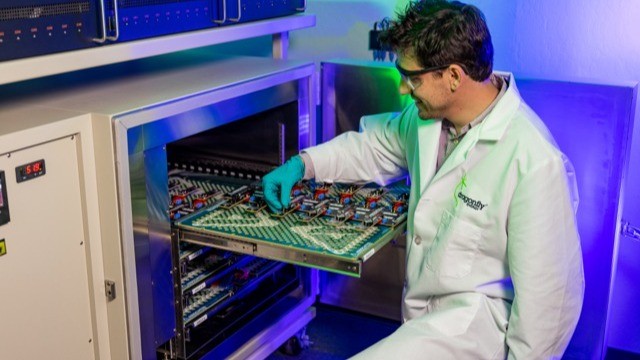
While certainly not alone in trying to carry out a dry electrode production technique, lithium battery and technology company Dragonfly Energy has upended battery manufacturing and successfully deployed a groundbreaking and patented process at a level sufficient to support large-scale production at a fraction of the cost. Driving cost efficiencies and presenting a safe and environmentally friendly approach, the method offers several advantages over its traditional wet counterpart.
Faster and less expensive than alternative approaches taken, it is a more economically viable solution. Using a patented doublesided dry deposition powder coating process, the progressive method uses an aerosolized dry powder for both the anode and cathode electrodes. The dry coating produces an electrode that’s ready for assembly into a cell without the long process of drying, significantly cutting down on overall production time. The patented technology also allows for better control over the electrode film properties, resulting in improved battery performance and long-term durability.
Additionally, addressing Europe’s proposition to ban the use of PFAS, Dragonfly Energy’s dry deposition methods can be applied to binders that don’t require PFAS chemicals. These safe, non-toxic processes are set to reduce emissions into the environment and contribute to enhanced safety in both consumer products and industrial processes.
The impact of a successful manufacturing approach
In the current landscape of cell manufacturing, dry deposition processes stand out, competently navigating the challenges found in dry electrode manufacturing, reshaping the future of lithium battery production, and extending benefits across three crucial dimensions: cost, safety, and sustainability.
Cost
A dry electrode process is inherently less expensive than the endeavoured wet slurry method as it eliminates the need for toxic solvents, large drying ovens, and more. Additionally, patented dry deposition manufacturing, like the method used by Dragonfly Energy, significantly streamlines the production process, reduces assembly time and cost, enables a smaller manufacturing footprint, and, in turn, makes lithium batteries more economically viable for widespread adoption.
This cost-effectiveness is vital in the grand scheme of a greener future, meeting demands with safer and highly efficient EV batteries, but also making renewable energy storage solutions widely accessible to a broad consumer base and taking stress off the grid.
Safety
The elimination of toxic solvents from manufacturing contributes to environmental sustainability and enhances safety in the production phase and for end-users. Using a dry deposition powder coating process also paves the way for fully scalable production and the widespread deployment of Dragonfly Energy’s completely non-flammable, all-solid-state battery cells.
Safety plays a pivotal role in embracing environmentally friendly solutions, propelling us closer to a greener future. This concept will enable homeowners and businesses to securely and confidently incorporate non-flammable energy storage systems and further welcome energy derived from renewable sources.
Sustainability
As the world continues its shift towards an environmentally conscious future, sustainability is a key consideration across every industry, every home, and every aspect of our lives. Amongst this shift is the widespread need for safe, affordable, and reliable lithium batteries.
To meet this growing energy demand, a dry electrode battery manufacturing process significantly reduces the environmental footprint of the extensively sought-after production of lithium batteries. By adopting such a technology, we can furthermore contribute to a more ecofriendly energy landscape.
A revolutionary approach to lithium battery production
The dream of a greener future, powered by efficient and sustainable lithium battery technology, is inching closer to reality thanks to groundbreaking dry electrode manufacturing processes. As technology companies across the globe grapple with the challenges of transitioning to dry-coating technology, making the manufacturing highly efficient and the end product widely implementable is the key to success; and it has been done using Dragonfly Energy’s proprietary and patented dry electrode battery cell manufacturing process.
The impact of a process like this extends into the entire landscape of lithium battery production. With improved cost-effectiveness, enhanced safety measures, and a reduced environmental footprint, the dry deposition processes serve as a beacon of hope and inspiration and pave the way for a more sustainable and accessible energy future.