Exclusive Articles

Beyond the Upfront Cost: Why a Redundant Pitch System is Your Turbine's Best Investment


Published in: Wind, Digital Blog


Beyond the Upfront Cost: Why a Redundant Pitch System is Your Turbine's Best Investment image

When evaluating wind turbine components, is a lower initial price tag blinding you to the total cost of ownership? The pitch system, which rotates each turbine blade to regulate power and ensure safety, is the turbines primary safety mechanism. While a simplified, low cost pitch solution may look appealing on paper, it rarely delivers long-term value and can increase risks and lifecycle costs.

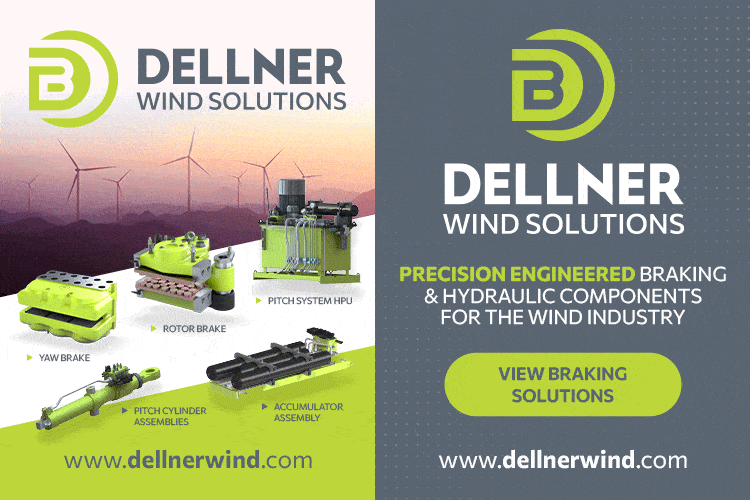
According to experts at Dellner Wind Solutions, a more robust and redundant pitch system may require a higher upfront investment, but it is ultimately more cost effective. Here’s why.

The Hidden Value: Reducing Loads Across the Entire Turbine

A key advantage of a superior pitch system is its ability to reduce mechanical loads on other critical turbine components, such as the tower, hub, or drivetrain. This is validated through Design Load Cases (DLCs) outlined in the international IEC 61400 standard, which simulates a turbines operational life to ensure it is appropriately engineered.

By investing more in pitch system safety and redundancy, the severity of some load cases can be significantly reduced. The additional cost for the pitch system is much less compared to the structural cost savings that can be gained in the tower or bedframe.

Built-in Safety: The Hydraulic Advantage

Hydraulic pitch systems remain a reliable choice due to their straightforward redundancy and built in energy storage. Using accumulators, these systems store energy that allows the blades to be brought to a safe stop during an emergency, even if primary power to the turbine is lost.

The Evolution of Redundancy

Modern pitch system design has evolved significantly to enhance safety, with a universal goal: all three blades must always be able to pitch.

  • Todays Baseline: The minimum standard for all turbine OEMs today is a configuration where each blade has its own separate actuators, position controls, and energy backup.
  • Enhanced Redundancy: Safety can be strengthened even further. Examples include adding a central energy backup for normal operation that can assist a failing blade in an emergency, or using separate hydraulic lines to ensure a single hose failure doesnt disable all cylinders on a blade.

Ultimately, the choice to invest in a higher-quality, redundant pitch system is a strategic one that enhances safety, improves reliability, and lowers the total cost of ownership for the entire wind turbine.

Learn more about advanced pitch and braking solutions from Dellner: https://www.dellnerwind.com/