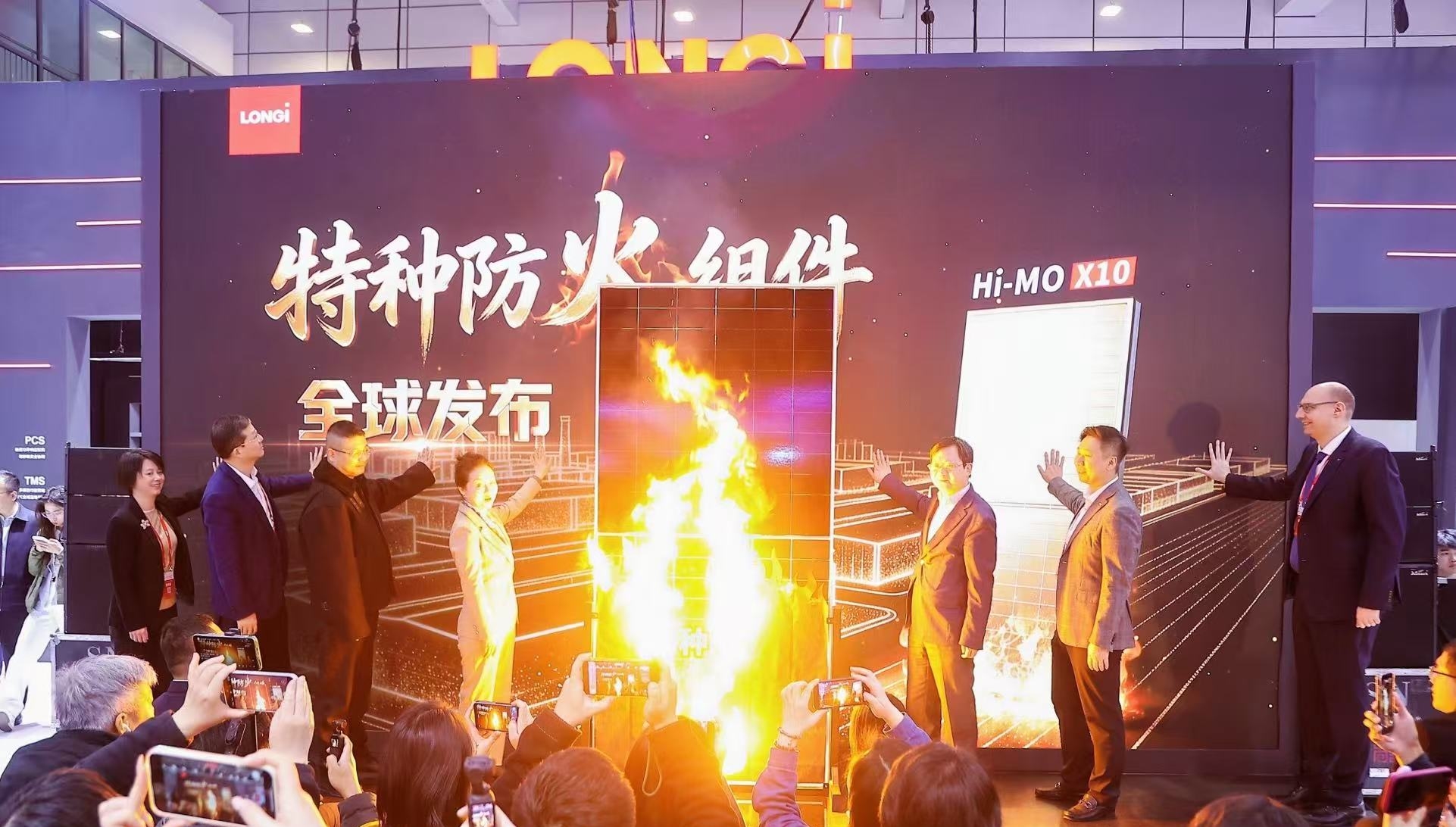
Frankfurt am Main, 17.03.2026 - LONGi has introduced the Hi-MO X10 fire-resistant PV module for distributed solar applications. It deploys second-generation hybrid passivated back contact (HPBC 2.0) cell technology and is designed to mitigate fire risks such as hot spots and direct current arcing. It is designed for safety-critical installations including warehouses, data centers, logistics facilities, and commercial rooftops, as well as residential PV.
The fire resistance is achieved through a multi-layered safety architecture. It includes specialized current-diversion structures, reinforced junction box sealing to reduce arc-related fault risks, flame-retardant materials, and high-temperature-resistant glass. Internal laboratory testing exposed the module to flame temperatures approaching 1000 °C for up to 1.5 hours under controlled conditions without structural burn-through, indicating enhanced resistance to flame penetration compared with conventional module constructions. The design is intended to slow flame penetration and help limit flame propagation in the event of an external fire. In addition, the module has obtained Class A fire classification from TÜV Rheinland and was also awarded the Fire Protection AAA certification for shading resistance, which evaluates the control of localized overheating under partial shading.
The module’s availability in the European market will be communicated in due course.
Integrated safety architecture with protection against hot spots, arcing, and flame exposure
The safety architecture integrates protection at the cell, string, and module level to address localized overheating and electrical arcing. A honeycomb current-diversion structure limits hot-spot formation, while a reinforced junction box sealing and welding design reduces the risk of direct current arc faults. Encapsulation and junction box components use flame-retardant materials, and the module incorporates high-temperature-resistant front glass designed for prolonged flame exposure. In internal laboratory testing under controlled conditions, the module was exposed to flame temperatures approaching 1000 °C for up to 1.5 hours without structural burn-through.
Alongside these safety features, the fire-resistant version uses 108 half-cells, supports a 1,500 V DC system architecture, and operates within a power range of 580 W to 630 W. It reaches a maximum conversion efficiency of 24.8 percent and an average mass-production efficiency above 24.5 percent. The module has a power temperature coefficient of -0.26 percent per degree Celsius and an operating temperature range of -40 to +85 degrees Celsius. The product retains the shading optimizer and anti-dust capabilities of the Hi-MO X10 family and includes a 30-year product and power warranty.
International testing standards and certifications confirm the safety and performance of the new module
The module has obtained Class A fire classification from TÜV Rheinland at the full-module, mass-production level. It was also awarded the Fire Protection AAA Certification for shading resistance from TÜV Rheinland, which evaluates the control of localized overheating under partial shading. Furthermore, the product has undergone performance and safety verification by China's National Center of Supervision and Inspection for Solar PV Products (CPVT) and complies with international standard testing under IEC 61215 and IEC 61730.
This development reflects a growing focus in the distributed photovoltaic market on application-specific module design. Beyond efficiency improvements, manufacturers are increasingly addressing operational risks such as dust accumulation, shading losses, structural constraints, and fire safety.
Fire remains a low-frequency but high-consequence risk in photovoltaic systems
Research indicates that photovoltaic-related fires remain uncommon but can have serious consequences when they occur. According to the Fraunhofer Institute for Solar Energy Systems ISE, the probability of a building being damaged by a PV-related fire is estimated at roughly 30 cases per one million installed systems per year. Investigations identify DC arc faults and localized overheating as the most common technical causes, underscoring the importance of module designs that mitigate electrical faults and thermal stress. The Hi-MO X10 fire-resistant module is designed to mitigate these risks through an integrated safety architecture addressing electrical arcing, localized overheating, and resistance to flame penetration.
Charles Jiang, Global President of LONGi Distributed Business, said photovoltaic-related fires are typically low-frequency but high-consequence events. “The available research shows that such incidents are relatively rare, but when they occur, they can result in serious property damage, operational disruption, and loss of investment value. That is why safety remains a fundamental requirement for long-term power generation and project returns.”
The module was introduced at the 19th China International Solar Utilization Conference and Exhibition (SUCE) on March 9, 2026.
Media Contact
Nadine Bütow
Head of European Communications (DG)
nadinebuetow@longi.com
Timo Helmke
PR Manager Europe (DG)
timohelmke@longi.com
About LONGi and LONGi Solar
LONGi Solar is one of the world’s largest solar technology companies. It is a subsidiary of LONGi Green Energy Technology (LONGi), which was founded in 2000. LONGi has 30+ locations and 30 manufacturing sites globally. LONGi Europe is headquartered in Frankfurt am Main, Germany. The company has established five business sectors, covering mono silicon, wafers, cells and modules, commercial and industrial as well as residential distributed solar solutions, green energy solutions and hydrogen equipment to support the development of zero-carbon energy globally.
Since 2021, LONGi has broken the photovoltaic (PV) cell conversion efficiency record 21 times in a row. In 2025, the company has set two new world records in solar cell efficiency: 27.81% for Heterojunction Interdigitated Back Contact (HIBC) cells (certified by ISFH, Germany) and 34.85% for crystalline silicon-perovskite tandem cells (certified by NREL, USA). In addition, LONGi launched its new Hybrid Passivated Back Contact (HPBC) 2.0 technology and currently holds the module efficiency world record of 25.4%. LONGi has decided to focus on back-contact technology as the solar technology of the future and has dedicated a significant portion of its annual production capacity to this technology. LONGi was also the first Chinese solar manufacturer to join the three distinguished climate initiatives RE100, EP100 and EV100. Under the Science Based Targets Initiative (SBTi), LONGi has set a 2030 emission reduction target aiming to reduce greenhouse gas emissions by 60 percent across its operations and productions compared to 2020 levels.
www.longi.com/eu


%20is%20especially%20important%20for%20smart%20energy%20systems.jpg)