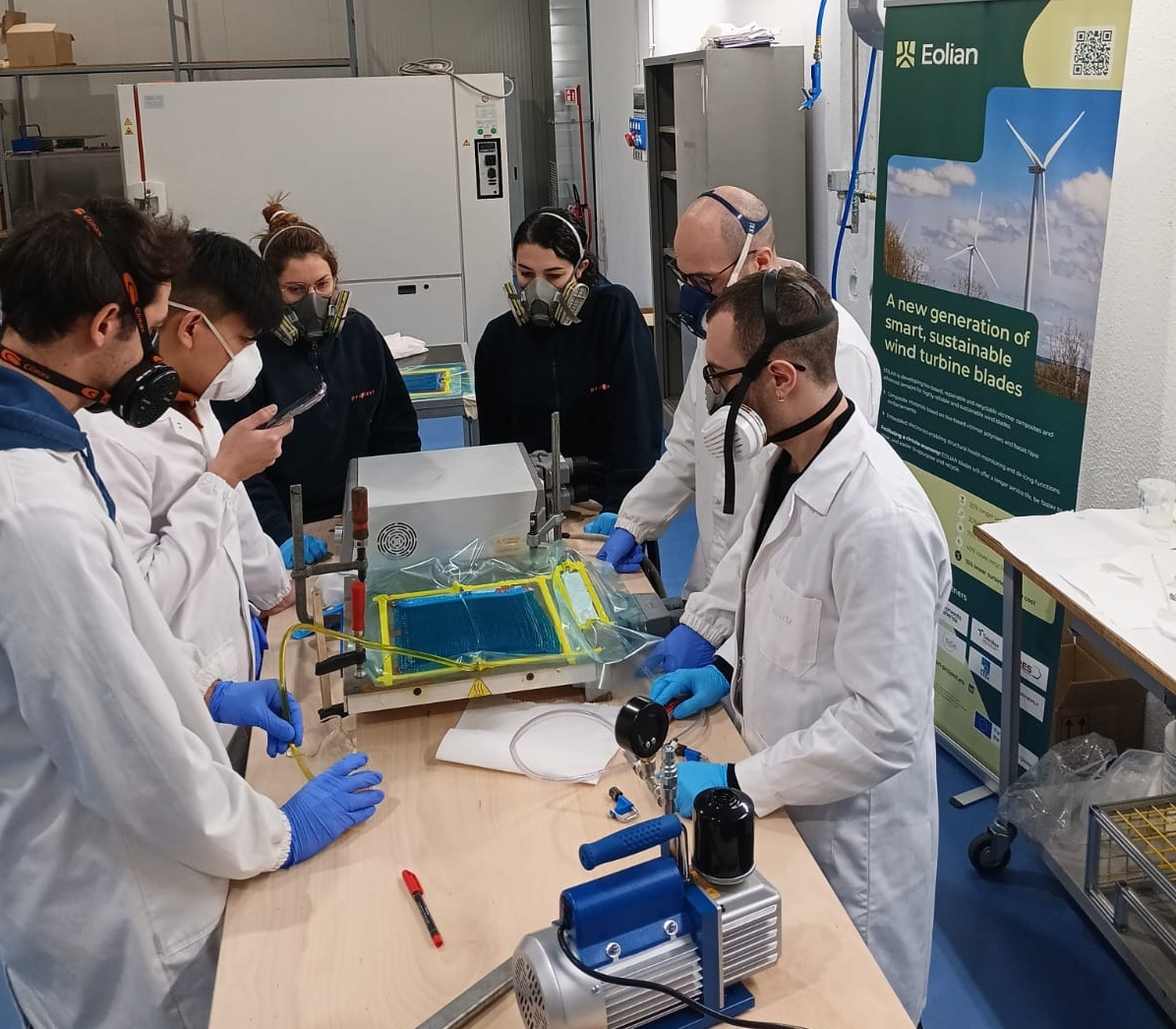
The EU-funded EOLIAN project has achieved a key milestone in its mission to develop a new generation of wind turbine blades manufactured using novel bio-based vitrimer composites. Project partners Proplast and Politecnico di Milano have succeeded in manufacturing basalt fibre reinforced vitrimer composite laminates using the infusion process.
“The fibre reinforced composites currently used to manufacture wind turbine blades are not easy to recycle,” explains EOLIAN project coordinator Marco Monti of Proplast. “In recent years, vitrimers have emerged as a potential breakthrough solution to this problem. The manufacture of bio-based vitrimer composites using the infusion process employed by blade manufacturers is extremely challenging and this achievement is an important first step towards our project’s goal – the production of a 12 m long vitrimer composite demonstration blade.”
Vitrimer composites – a more sustainable alternative
Driven by the need to reduce environmental impact, wind turbine blade manufacturers are actively seeking more sustainable, circular materials to substitute the glass fibre reinforced thermoset composites currently used in blade production. EOLIAN is addressing this demand by developing a new generation of composite materials combining a bio-based vitrimer matrix with natural basalt fibre reinforcement. The unique properties of vitrimers – including repairability, reprocessability, and recyclability – will contribute to enhanced sustainability throughout the blade’s life cycle. Vitrimers also pave the way to different end-of-life strategies, from reuse through thermoforming, to chemical recycling enabling separation of fibre from matrix.
In order to realise these potential benefits EOLIAN must however develop vitrimer formulations that satisfy the wind industry's stringent standards for performance, manufacturing, and cost. A strategy for transitioning these innovative materials from laboratory to industrial application is also essential.
Promising progress
EOLIAN partner Tekniker is leading the synthesis of imine-based vitrimers using sustainable building blocks such as vanillin and epoxidised vegetable oils, which are available at industrial scale at reasonable price. As well as being compatible with the infusion process, the vitrimers must possess the thermo-mechanical properties required by the wind energy sector while maintaining their vitrimeric behaviour. The vitrimer matrices should also be reprocessable, repairable, and easily recyclable at ‘soft’ conditions (low temperature and pressure, without the use of sophisticated equipment).
EOLIAN has successfully developed vitrimers with a bio-based content of 60% which demonstrate key vitrimer properties such as reprocessability and repairability. Proplast and the Polymer Engineering Lab (PolyEngLab) at Politecnico di Milano have carried out infusion trials using the most promising formulations. The high viscosity and short pot-life of vitrimers typically make infusion challenging. However, in recent tests the EOLIAN team has successfully manufactured high-quality basalt fibre reinforced laminates at moderate temperatures (room temperature up to 80°C). The composites exhibit optimised fibre volume fraction and low void content.
Research and testing are continuing to refine the vitrimer formulations and achieve the optimal balance between bio-based content, processability, and final performance to ensure their successful implementation in blade manufacturing.
Cristina Monteserin, Researcher, Tekniker: “The work being carried out within EOLIAN represents a significant step forward in the development of high-performance, eco-friendly vitrimer composites. With growing global emphasis on green energy and circular economy principles, these innovations could play a transformative role in the future of sustainable materials for the wind energy sector and beyond.”
Marco L. Longana, Associate Professor, Politecnico di Milano: “By participating in EOLIAN, PolyEngLab is pushing the boundaries of sustainable polymer composites, ensuring that future wind turbine blades are more durable, repairable, and recyclable. This project strengthens our position as a leader in advanced materials research while supporting EU sustainability goals.”
Next steps
In parallel with materials development, characterisation and testing, EOLIAN is developing a structural health monitoring system to enable the early identification of typical blade damage. This will employ in-mould electronics processes to embed erosion and ice detection sensors into the composite material. This innovation will help to extend the blade’s service life, maintain the turbine’s performance and safety, and reduce maintenance costs.
To demonstrate the technologies developed within the project, Norvento Enerxía is preparing for the manufacture of the EOLIAN prototype sensor-assisted vitrimer composite blade. This will be benchmarked against a traditional glass fibre epoxy composite blade, and a detailed LCOE (Levelised Cost of Energy) analysis and a life cycle assessment (LCA) will be performed. This data will provide project partners and the wider wind industry with valuable insights into the benefits of these new materials, and ways to optimise future blade design and manufacture.
Further information
More information about EOLIAN’s objectives and technologies is available in the presentations from our recent online workshop:
EOLIAN website: https://eolian-project.eu/publications/
YouTube: https://www.youtube.com/@EOLIANproject
Press enquiries
Amanda Jacob, Communication Manager, EuCIA | Communications team, EOLIAN
Email: amanda.jacob@eucia.eu
About EOLIAN
EOLIAN – Bio-based, repairable and recyclable vitrimer composites and advanced sensors for highly reliable, sustainable wind blades – is developing a new generation of smart, sustainable wind turbine blades manufactured from repairable and recyclable composite materials, with an integrated structural health monitoring system that will detect damage before it becomes a major issue. EOLIAN will demonstrate these technologies by manufacturing a sensor-assisted vitrimer composite blade of 12 m in length.
The project consortium brings together 10 organisations from five countries: project coordinator Proplast (Italy); AEP Polymers (Italy); Brunel University London (UK); Entelea (UK); EuCIA (Belgium); IRES (Belgium); Norvento (Spain); Politecnico di Milano (Italy); Tekniker (Spain); and Zorlu Enerji (Türkiye).
EOLIAN has received funding from the European Union’s Horizon Europe research and innovation programme under grant agreement no. 101147532. The project commenced in June 2024 and will run until the end of November 2027.


.jpg)