Exclusive Articles

Rotor blade recycling: the hidden challenge facing wind energy


Published in: Wind, Exclusive Articles, Industrial Insight

Rotor blade recycling: the hidden challenge facing wind energy image

As a central element of a wind turbine, a rotor blade not only plays a decisive role in energy conversion but also makes a significant contribution to the cost efficiency and energy yield of the turbine overall. With sustainability and environmentally friendly solutions becoming increasingly important, the recycling of rotor blades is becoming increasingly relevant.

High-quality recycling requires a detailed understanding of the specific materials used in the construction of rotor blades.

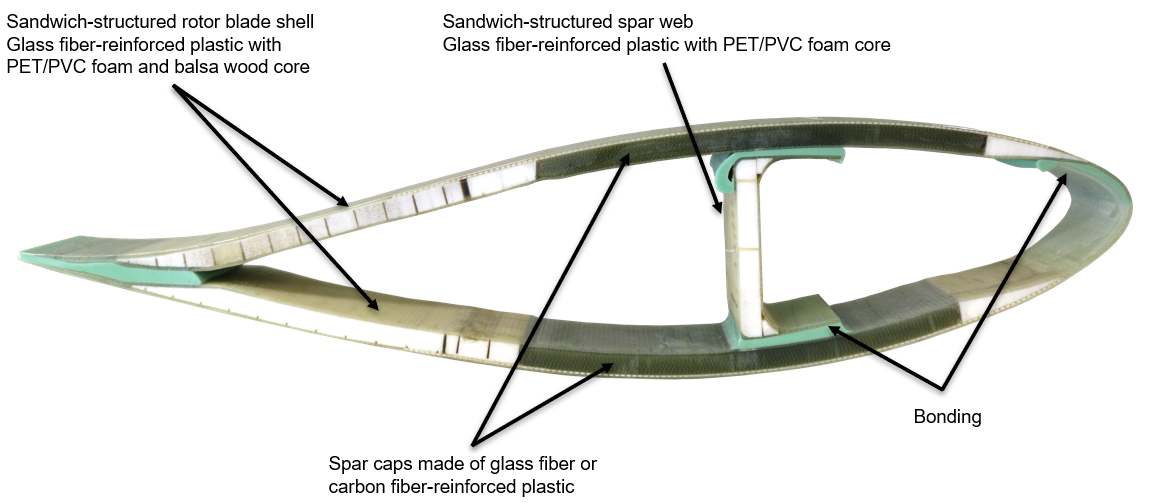
A rotor blade is essentially made of fiber-reinforced composite materials such as glass fiber and carbon fiber, sandwich materials such as balsa wood and PET foam, and a thermoset matrix. The matrix, nowadays usually based on epoxy resin, permanently bonds the components together.

The smart combination of sandwich materials with spar caps made of glass fiber produces very light and highly buckling-resistant panels. Balsa wood is usually employed as the sandwich material in the first third of the rotor blade. Further towards the blade tip, a lighter PET foam is used.

The main load of the rotor blade is borne by a spar-web system with a solid laminate spar on both sides and a web of sandwich materials. The flange, the connection to the rotor blade hub, is also made of solid glass fiber laminate.

 Download full article