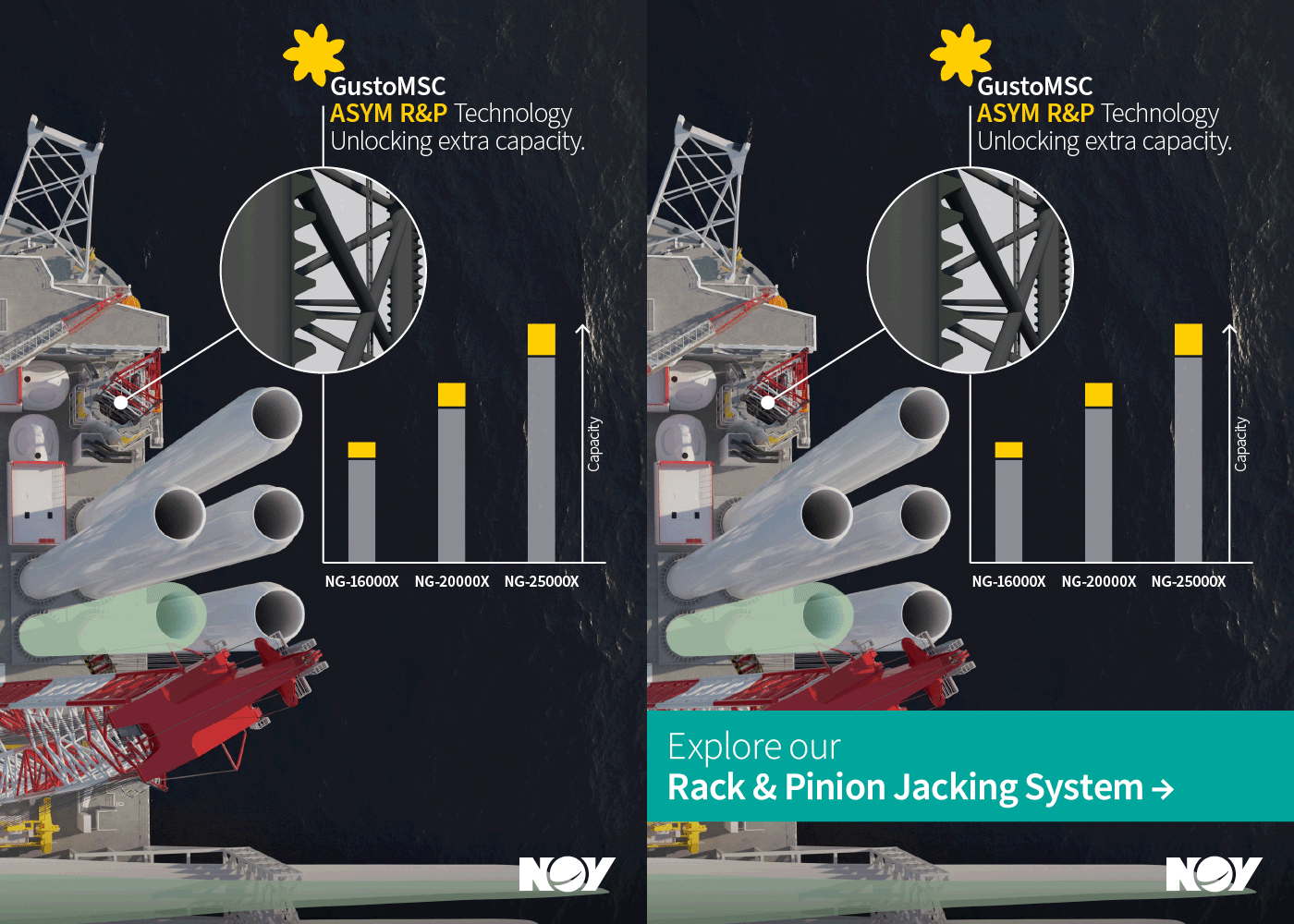
As offshore wind foundations expand on a monumental scale, monopile diameters are regularly surpassing 10 metres, with weights exceeding 2,000 tonnes. This extraordinary growth does far more than challenge manufacturing logistics, because it fundamentally alters how installation behaves structurally.
Traditionally, lowering a monopile from air into water was viewed as a routine operational step limited mainly by crane capacity. However, detailed engineering analysis by GustoMSC reveals that this partial submersion phase can actually govern the structural demand of the entire jack-up vessel. In certain components, installation loads can approach and even exceed those associated with extreme 50 year survival conditions.
The primary driver is not heavier lifting alone, but the coupled dynamic interaction between the hydrodynamically active pile and the flexible jack-up vessel.
A suspended structure, not suspended cargo
When the full weight of a massive monopile hangs from the crane and is laterally restrained by the vessel gripper, it cannot be treated as passive cargo. It behaves as a massive structure exposed to severe wave and current loading.
- The dominant source of loading: For large-diameter foundations, wave forces acting directly on the monopile can be several times higher than those acting on the slender jack-up legs. This makes the suspended pile the dominant source of horizontal loading on the entire system.
- The flex feedback loop: As wave forces hit the hydrodynamically active body, its movements begin to influence the jack-up. The inherent structural flexibility of the vessel hull and legs allows these motions to feed back into the pile, creating a coupled system where motions reinforce one another.
- The critical submersion zone: The highest dynamic loads occur during partial submersion, specifically in the 10 to 15 metre range. At this depth, a massive portion of the pile absorbs wave energy while remaining strongly connected to the vessel.
Static baseline and foundation safety
Dynamic amplification develops on top of an already highly demanding static load condition. Transferring a 2,500 tonne monopile from deck storage to the crane introduces a massive shift in vertical load, accounting for roughly 30% of the total vertical load at the most heavily loaded leg.
As crane pedestal moments deform the hull, vertical loads are redistributed unevenly across the foundations. When significant lateral hydrodynamic forces from the wave-exposed pile combine with these high static vertical loads, the heavily loaded leg is pushed directly toward its design bearing capacity envelope. Consequently, foundation safety during installation relies as much on the behavior of the suspended pile as on the jack-up itself.
Practical implications for modern fleets
Simplified, uncoupled models that treat the monopile purely as a suspended weight fail to capture hydrodynamic inertia and structural resonance. As diameters push toward 12 to 15 metres, current standalone standards are no longer sufficient to guarantee operational safety.
For operators preparing for next-generation assets, several critical steps follow:
- Perform coupled analyses: Fully integrate structural jack-up flexibility, crane mechanisms and wave-pile interaction into a single model.
- Evaluate multiple wave headings: Wave direction is a decisive factor, because certain headings excite motion about the gripper location far more effectively.
- Assess partial submersion risk: Account for structural component stress peaks specifically during the splash zone transition, rather than assuming full depth is the worst-case scenario.
Lowering a modern foundation through the splash zone may only take a few minutes, but it represents one of the most demanding phases of offshore wind construction. Moving past project-isolated assumptions and embracing coupled dynamic analysis is essential to safeguard multi-million-pound vessels and secure marine installation schedules.
How is your engineering team adapting its installation analyses to account for coupled dynamic risks as foundation sizes scale up? Share your thoughts in the comments below.
Looking for the full technical breakdown? To read the complete case study on large monopile lowering analytics and coupled jack-up mechanics, visit the original article on the PES Wind or NOV GustoMSC website: https://pes.eu.com/exclusive-articles/rethinking-load-cases-for-large-monopile-installation
-1.jpg)