In 2023, the photovoltaic power installed in Europe was estimated at about 56 GW according to the latest Solar Power Europe report. That is a growth of more than 40% compared to 2022. With 14 countries among the 27 member states exceeding 1 GW of annual installations in 2023, Europe continues to show great dynamism across all rooftop segments. Residential, commercial and industrial (C&I) experienced a very good year in 2023, growing together by 54% year-on-year, but the C&I segment improved the most.
While self-consumption continues to be a strong driver for growth in residential solar, with the DS3 microinverter series connecting two high power PV modules in single phase, APsystems has also launched a range of multimodule microinverters dedicated to the threephase network on the European market.
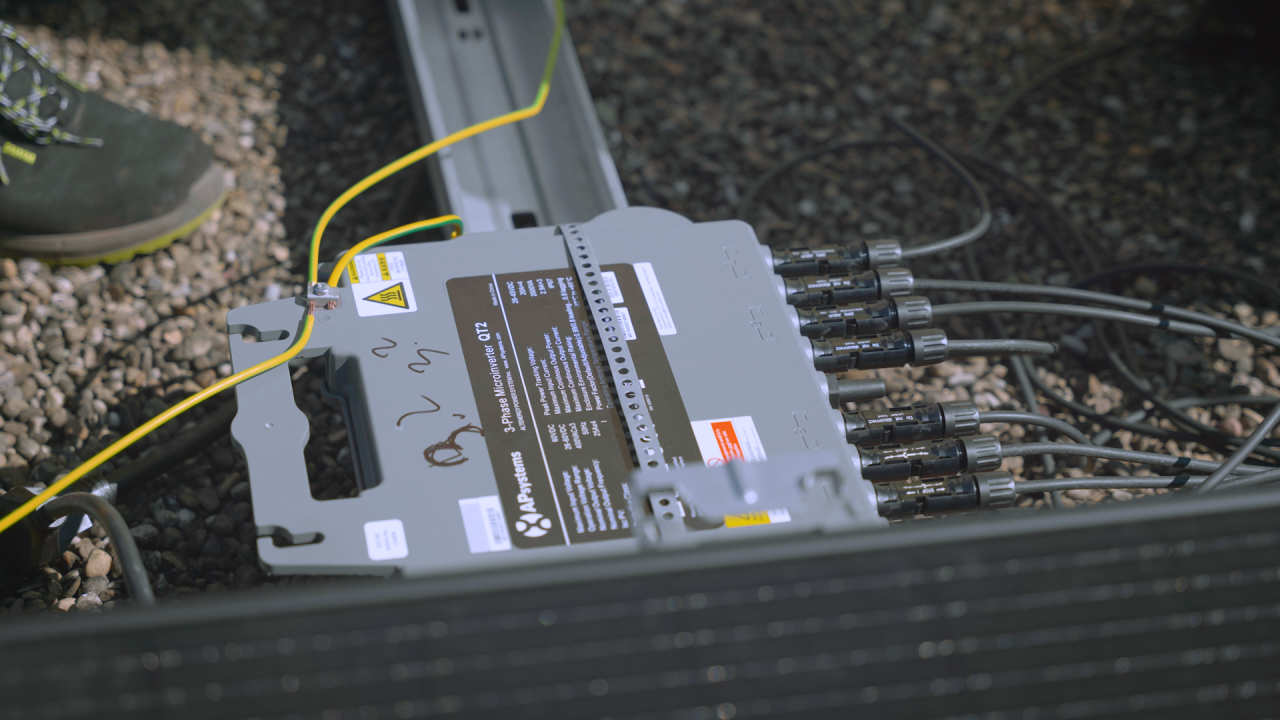
The QT2 and QT2D, second generation native three-phase microinverter connecting four or up to eight high-power modules, have recently been chosen for several large-scale installations in schools, commercial buildings, but also in agricultural environments.
A 250 kWp agrivoltaics project in Vendée, France
‘In this installation we recommended that the client create 232 kWp of grid connected PV power to sell to the grid and 18 kWp of self-consumption to supply the agricultural warehouses,’ explains Jean-Philippe Lévêque, Director of Energie Solaire 85. The installation company responsible for the project with its partner Hellio, has specialized in photovoltaic energy since 2017 and has carried out more than 240 APsystems installations, from 3 to 250 kWp.
Armel G, manager of the end client Les Sources, explains more about the project. ‘With the installation as it is, it will provide me with around €33,000 to €34,000 per year in resale. Furthermore, producing energy should eliminate around 50% of my bill, which currently costs me around €7,500 per year in electricity.’
For this specific fiber cement roof project, a structural study resulted in reinforcements. A Dome Solar mounting system was then used to install each 500 W panel. Each QT2 microinverter connects four solar panels of 500 W each.
The QT2 on the roof of the Steinmetz furniture brand in Alsace, France
In Alsace. Furniture brand Steinmetz, through our partners Airwell and Pompac, opted for a 136 kWp roof with 68 microinverters guaranteed for 20 years. The optimal production of photovoltaic modules and an incomparable level of security in a building of type ERP 1 were decisive in the customer’s choice.
Yannick Shildknecht, Sales Manager from Pompac distribution explains, ‘The goal was to reduce electricity consumption. This project was done in three stages. We started with a building consumption assessment. We checked the available surface area on the roof and we checked the orientations and also the shading. Our historical partner Airwell directed us towards Airsolar high performance PV modules and the QT2 microinverters from APsystems.’
Karim Al Mouatassim, Development Manager at Airwell, added: ‘Airwell positioned itself an integrator for this project. We have integrated the microinverter with our photovoltaic modules that comply with the low carbon standards imposed on commercial buildings. The microinverter from APsystems together with our own PV modules, allowed us to propose a differentiated offer for this project.’
Fabrice Besson, Manager from the installer COREBAT continues: ‘With 2000 watts, the input and output power offered by the device, allow to connect four high power PV modules. The increase in size and power for PV modules is a general trend we are observing. Another big advantage is the encrypted Zigbee communication protocol, ensuring data confidentiality for the end user. The AC current on the roof reassured everyone on the project and influenced our choice.’
Maximum safety for the Augustiniano school in Mixco, Guatemala
For a school in Guatemala, a 220 kWp project has 100 QT2 microinverters supplying electricity to the establishment. There is no risk of electric arc and fire, thanks to the very low direct voltage that is directly converted into alternating current at the level of each photovoltaic module. The installation has 400 photovoltaic modules of 550 W each, contributing to the reduction of carbon emissions and a self-consumption rate of almost 90% for the user.
Another example is the Cooedumag school in Santa Marta, Colombia where a 117 kWp project was installed with the QT2. 54 QT2 microinverters, connecting 216 modules of 545 Wp each.
Why opt for a microinverter in a C&I installation?
‘The principle of the APsystems microinverter that was implemented is a native three-phase microinverter that will directly convert the energy of each of the panels. Thus, each panel will become its own energy producer. This will overcome all the problems that a panel could encounter in terms of production, weather shadows, dirt, anything that has the effect of reducing the production of the panel itself,’ declares Aymeric Chollet, EMEA Sales Director at APsystems. ‘Working with APsystems Microinverters allows us to monitor all the panels of all our clients in real time and have better after-sales service,’ he concludes.
Many design firms are now aware that microinverters produce more power and require minimal maintenance, and that the low initial cost is largely offset by a lower levelized cost of energy (LCoE) over the life of the plant. Overall, the benefits highlight the superior performance, economic advantages over the long term, and sustainability of microinverters in comparison to traditional inverters in solar energy systems.
Microinverters are known to optimize the performance of individual solar panels. By converting the DC (direct current) output from each panel into AC (alternating current) independently, microinverters can maximize energy harvest even when some panels are partially shaded or experiencing varying sunlight conditions.
Microinverters provide a more flexible and scalable solution for C&I projects too. The modular nature of microinverter systems allows for easy expansion or modification of the solar array, accommodating the changing energy needs of commercial and industrial facilities. Many microinverter systems come with advanced monitoring capabilities. This allows for real-time monitoring of each solar panel’s performance, making it easier to detect and address issues promptly.
The proactive approach to maintenance contributes to system reliability and overall performance. The independent operation of microinverters ensures that the failure of one inverter does not affect the entire solar array. This decentralized design minimizes the risk of system downtime due to a single point of failure, providing greater reliability for C&I projects. Microinverters can be advantageous in scenarios where space is limited. Their distributed architecture eliminates the need for a centralized inverter station, potentially saving space in C&I projects where real estate is at a premium.
While the initial cost of microinverters may be higher, the advantages mentioned, such as enhanced performance, monitoring capabilities, and reduced downtime, contribute to long-term financial benefits. The overall return on investment (ROI) for C&I projects may be favorable.
C&I projects often involve complex installations with various roof orientations and shading conditions. Microinverters can adapt well to such scenarios, optimizing energy production across diverse and challenging environments.
In summary, the benefits associated with microinverters in C&I projects include improved performance, flexibility, monitoring capabilities, safety features, and financial advantages over the long term. These factors contribute to making microinverters a highly beneficial choice for commercial and industrial solar energy installations.
To ease the transition among the PV designer community, APsystems developed and released APdesigner, a PV sizing tool helping designers to quickly complete their APsystems PV system design and generate an evaluation report automatically.
APsystems is dedicated to continuous products R&D, focusing on innovation on microinverters while ensuring product reliability and cost reduction. The latest generation of three-phase microinverters, the company’s flagship product, will enable solar stations to evolve into long-term, reliable, and high-quality assets.





-1.jpg)