In the complex mechanics of a wind turbine, brakes are a central and critical component. Among the most important are the yaw brakes, which work tirelessly to keep the massive nacelle perfectly aligned with the wind. While the industry has long relied on either fully active or fully passive systems, an innovative solution is gaining wider acceptance: hybrid brakes.
This often-overlooked technology harnesses the best of both worlds, combining active and passive systems into a single, highly efficient product. Let's explore how this smart engineering is enhancing performance, reducing costs, and improving safety for the next generation of wind turbines.
Understanding the Technology: Active, Passive, and Hybrid
To appreciate the benefits of a hybrid system, it's important to understand the two core technologies it combines.
- Active Yaw Brakes: These systems use high hydraulic pressure to hold the nacelle in place against the wind and low pressure when the nacelle needs to yaw (rotate).
- Passive Yaw Brakes: These systems apply a constant mechanical force to keep the turbine rotor facing the wind.
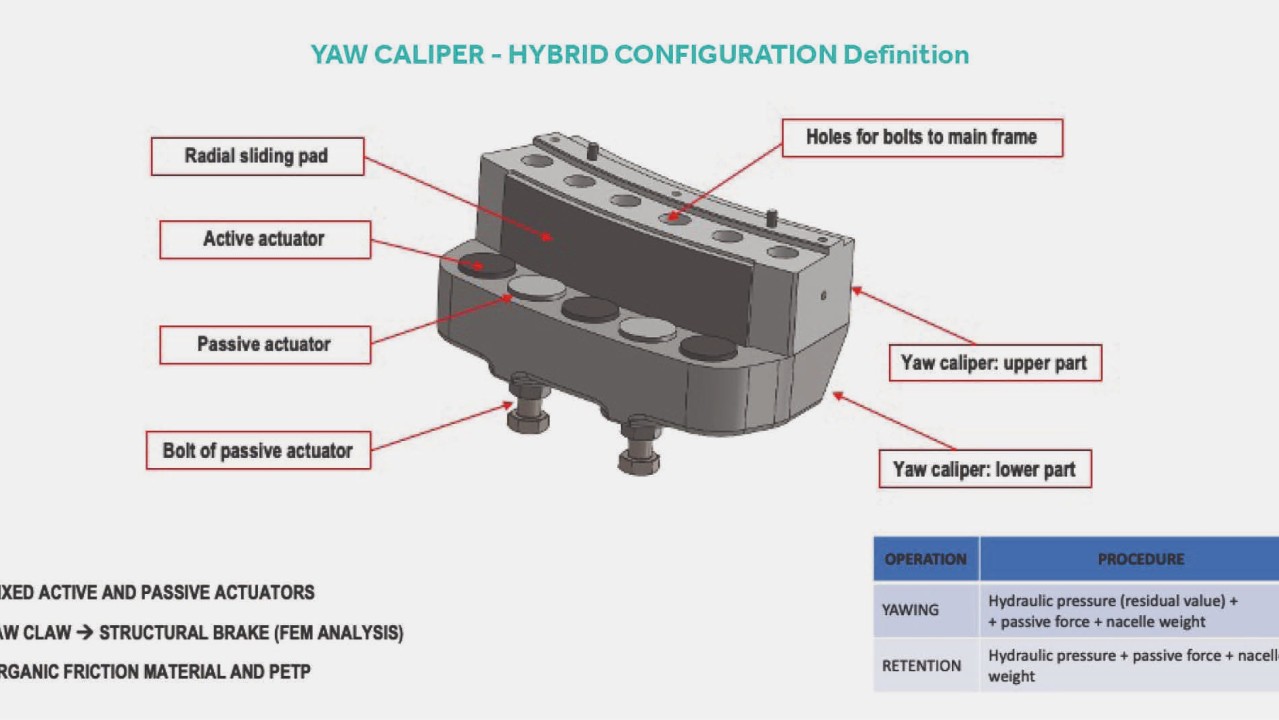
A hybrid brake is a yaw claw that integrates both active (hydraulic) and passive (mechanical) actuators.
- Passive actuators with plastic pads manage the sliding and support the yawing function.
- Active actuators are used to increase the retention torque, which reduces the strain and demand on the yaw gears.
This combination creates a sophisticated, tailored solution for each wind turbine generator (WTG).
The Advantages Outweigh the Drawbacks
While hybrid systems have a clear disadvantage compared to fully passive ones—they require a hydraulic power unit (HPU)—the benefits are compelling industry stakeholders to take a closer look.
Key advantages include:
- Reduced cost of acquisition and maintenance on yaw gears.
- Improved torque control, leading to more precise and stable operation.
- Lower noise risk and reduced wear on linings, thanks to the use of plastic pads during yawing
OEMs like Siemens Gamesa have already successfully implemented this hybrid brake technology, demonstrating its viability and benefits in the field. For other OEMs currently using bearing yawing systems, a shift to hybrid brakes would require a design change to a sliding-ring system, which is a more cost-efficient approach.
Industry Momentum and Key Players
The groundswell of support for hybrid technology is growing, bolstered by key strategic moves in the industry. The recent acquisition of Antec, a long-time supplier of hybrid brakes, by the Dellner Group has been a major catalyst.
This move brought Antecs operations in Spain, China, and Brazil under the Dellner umbrella, significantly expanding the groups global reach. Combined with other acquisitions, such as Dellner Hydratech and Pintsch Bubenzer, the newly formed Dellner Bubenzer Group is placing hybrid technology at the core of its strategy to enhance safety through improved yawing retention.
As Antec CEO Pepe Traspaderne said of the merger, I am confident that together, we will make Dellner Wind and Dellner Bubenzer even stronger, delivering top-quality products and services to our customers as one united family.
A Market in Transition
The rise of solutions like hybrid brakes reflects a broader trend in the wind industry: the transition from build-to-spec to build-to-print.
- Build-to-spec is a process where a manufacturer designs a solution from scratch based on a clients desired outcomes, using decades of engineering know-how.
- Build-to-print involves building products according to a clients exact work instructions, often for components of a larger machine.
As the industry moves toward greater industrialization and serial production similar to the automotive sector the deep engineering collaboration inherent in the build-to-spec process remains crucial for developing sophisticated, tailored solutions like hybrid brakes.